NGC 1395
NGC 1395 is a galaxy in the constellation Eridanus, magnitude 9.7, 4.7′ × 4.0′ across.
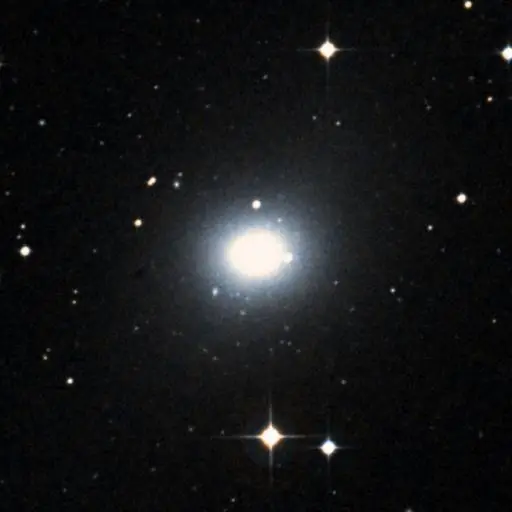
An elliptical giant with some 6,000 globular clusters — and the faint shells of a recent meal.
The Milky Way has about 150 to 200 globular clusters. NGC 1395 has around 6,000. Many probably came from dwarf galaxies it has swallowed over time. In 1983 David Malin and Dave Carter found faint shells in its outer glow — ripples of stars that point to a smaller galaxy captured not long ago.
This elliptical galaxy is the brightest of its subgroup in the Eridanus Cluster. William Herschel discovered it on 17 November 1784.
NGC 1395 is 79 million light-years away: the light we see from it set off about 79 million years ago, when dinosaurs still walked the Earth.
How big is it?
About as wide as our Milky Way. Light itself takes 110,000 years to cross it. Shrink it to the length of a football pitch and our whole Solar System would be smaller than a bacterium.
A 9.7-magnitude elliptical galaxy (E) in Eridanus, about 4.7′ × 4′.
When and where to see it
It is best placed in the evening sky around December, when it crosses the meridian at about 10 pm local time (around midnight in November). It can be seen from everywhere south of 67°N and never sets south of 67°S.
At its highest it stands 17° up from 50°N, 32° up from 35°N, 67° up from the equator, 78° up from 35°S.
Facts
- Type
- Galaxy
- Constellation
- Eridanus
- Designations
- NGC 1395
- Magnitude
- 9.7
- Apparent size
- 4.7′ × 4.0′
- Position
- RA 3h 38.5m, Dec −23° 2′ (J2000)
- Distance
- 79 million light-years
- Discovered
- William Herschel, 1784
Open AstroPilot to see when NGC 1395 is highest tonight from your location, how easy it is with your telescope or binoculars, and an eyepiece view.