NGC 1380
NGC 1380 is a galaxy in the constellation Fornax, magnitude 9.9, 4.6′ × 2.2′ across.
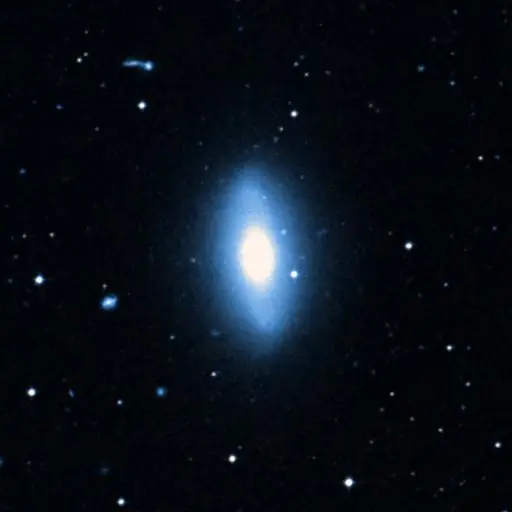
A smooth lenticular galaxy that swallowed a fifth of its own mass 10 billion years ago.
About 10 billion years ago NGC 1380 swallowed another galaxy whole. The victim added roughly a fifth of its present mass, and traces of it survive in the stars of its inner halo. Today NGC 1380 is a calm lenticular galaxy near the heart of the Fornax Cluster, with about 555 globular clusters and a central black hole of some 220 million Suns. James Dunlop discovered it on 2 September 1826.
NGC 1380 is 57 million light-years away: the light we see from it set off about 57 million years ago, when mammals were taking over a world without dinosaurs.
Did you know?
- Found twice in two days. Its one known supernova, SN 1992A, was spotted by W. Liller on 11 January 1992 and independently by N. Brown the next day.
How big is it?
76% of the Milky Way’s width. Light itself takes 76,000 years to cross it. Shrink it to the length of a football pitch and our whole Solar System would be smaller than a bacterium.
A 9.9-magnitude lenticular galaxy (S0) in Fornax, about 4.6′ × 2.2′.
When and where to see it
It is best placed in the evening sky around December, when it crosses the meridian at about 10 pm local time (around midnight in November). It can be seen from everywhere south of 55°N and never sets south of 55°S.
At its highest it stands 5° up from 50°N, 20° up from 35°N, 55° up from the equator, 90° up from 35°S.
Facts
- Type
- Galaxy
- Constellation
- Fornax
- Designations
- NGC 1380
- Magnitude
- 9.9
- Apparent size
- 4.6′ × 2.2′
- Position
- RA 3h 36.5m, Dec −34° 59′ (J2000)
- Distance
- 57 million light-years
- Discovered
- James Dunlop, 1826
Open AstroPilot to see when NGC 1380 is highest tonight from your location, how easy it is with your telescope or binoculars, and an eyepiece view.