47 Tucanae (NGC 104)
47 Tucanae (NGC 104) is a globular cluster in the constellation Tucana, magnitude 4.0, 44′ across.
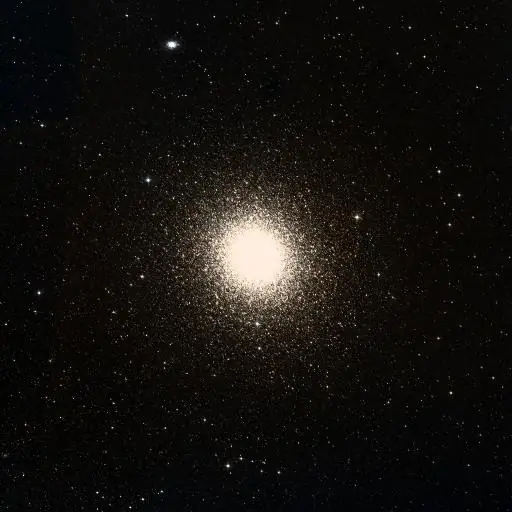
Millions of stars around 13 billion years old, with dozens of cosmic lighthouses spinning inside it.
When Nicolas-Louis de Lacaille first saw it from South Africa in 1751, he thought it was the head of a bright comet. It was in fact a globular cluster — one of the most massive in our galaxy, holding millions of stars, many of them crowded into a small, dense core. He made it the first entry in his catalogue of southern deep-sky objects.
Its name comes from Johann Elert Bode, who in 1801 reordered Lacaille’s stars by constellation and gave it the number 47 — without ever seeing it. Its stars are about 13 billion years old, unusually old even for a globular cluster. A Hubble search of its core for planets, expected to find ten to fifteen, found none at all: planets seem to be rare where heavy elements are scarce.
47 Tucanae (NGC 104) is 15,000 light-years away: the light we see from it set off about 15,000 years ago, when the last Ice Age was at its height, and mammoths roamed beneath the ice sheets.
Did you know?
- Spinning lighthouses. 47 Tucanae holds 35 known millisecond pulsars — dead stars spinning hundreds of times a second — the second-largest haul in any globular cluster. It was the first globular cluster detected in gamma rays.
- A hidden black hole?. In 2017 astronomers reported signs of a black hole of about 2,200 suns at the centre, traced through the motions of its pulsars. Later timing data gave no solid evidence for it, so the question is still open.
- Not next door. In the sky 47 Tucanae sits beside the Small Magellanic Cloud, but the two are unrelated: the Small Cloud is more than fifteen times farther away.
How big is it?
About 850,000 Suns’ worth of stars in a ball 191 light-years wide. Light itself takes 191 years to cross it. That’s 45 times the distance from the Sun to the nearest star. In its core the stars are packed so tightly that each one’s nearest neighbour is about 25 light-days away. Our nearest neighbour, Proxima Centauri, is 4.2 light-years from the Sun — 61 times farther. To break free from its centre, a star would need 47 km/s — 4.2 times the speed a rocket needs to leave Earth. It will hold together for another 106 billion years or so — longer than the universe has existed. Shrink our Solar System — the Sun and all eight planets — to the size of a coin, and 47 Tucanae would be 4.82 km across (an hour’s walk); the nearest star would be a football pitch away, and the Milky Way 2,520 km across.
The second-brightest globular cluster after Omega Centauri, visible to the naked eye beside the Small Magellanic Cloud; a superb sight with a dense, bright core.
When and where to see it
It is best placed in the evening sky around November, when it crosses the meridian at about 10 pm local time (around midnight in September). It can be seen from everywhere south of 18°N and never sets south of 18°S.
At its highest it stands below the horizon from 50°N, below the horizon from 35°N, 18° up from the equator, 53° up from 35°S.
Facts
- Type
- Globular cluster
- Constellation
- Tucana
- Designations
- NGC 104, C 106, Mel 1, 47 Tucanae Cluster, Melotte 1
- Magnitude
- 4.0
- Apparent size
- 44′
- Position
- RA 0h 24.1m, Dec −72° 5′ (J2000)
- Distance
- 15,000 light-years
- Discovered
- Nicolas-Louis de Lacaille, 1751
Open AstroPilot to see when 47 Tucanae (NGC 104) is highest tonight from your location, how easy it is with your telescope or binoculars, and an eyepiece view.