MWSC 3171 (Pal 11)
MWSC 3171 (Pal 11) is a globular cluster in the constellation Aquila, magnitude 9.8, 5.4′ across.
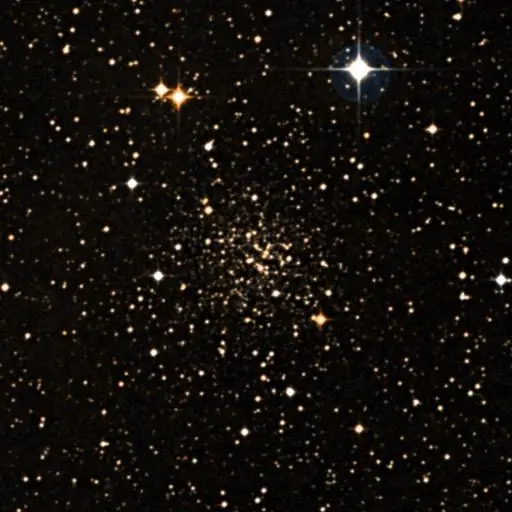
Palomar 11: a globular cluster in Aquila so hidden by dust that it was found only in the 1950s.
Even a ball of many thousands of stars can hide. Palomar 11 is an ordinary-sized globular cluster in Aquila, but it sits behind so much dust in the plane of the Milky Way that nobody noticed it until the 1950s. It turned up on plates from the first Palomar Observatory Sky Survey, taken with the 48-inch Schmidt camera — one of 15 faint globulars the survey revealed. Here it is listed as MWSC 3171, its number in a modern catalogue of Milky Way star clusters.
MWSC 3171 (Pal 11) is 46,000 light-years away: the light we see from it set off about 46,000 years ago, when people were painting the oldest known cave art.
How big is it?
About 14,000 Suns’ worth of stars in a ball 72 light-years wide. Light itself takes 72 years to cross it. That’s 17 times the distance from the Sun to the nearest star. In its core the stars are packed so tightly that each one’s nearest neighbour is about 17 light-months away. Our nearest neighbour, Proxima Centauri, is 4.2 light-years from the Sun — 3 times farther. To break free from its centre, a star would need 4 km/s — less than the 11.2 km/s a rocket needs to leave Earth. The Milky Way’s tides will pull it apart in about 3.4 billion years. Shrink our Solar System — the Sun and all eight planets — to the size of a coin, and MWSC 3171 would be 1.82 km across (a 20-minute walk); the nearest star would be a football pitch away, and the Milky Way 2,520 km across.
A 9.8-magnitude globular cluster in Aquila, about 5.4′ across. It lies about 44,000 light-years away.
When and where to see it
It is best placed in the evening sky around August, when it crosses the meridian at about 10 pm local time (around midnight in July). It can be seen from everywhere south of 82°N and never sets south of 82°S.
At its highest it stands 32° up from 50°N, 47° up from 35°N, 82° up from the equator, 63° up from 35°S.
Facts
- Type
- Globular cluster
- Constellation
- Aquila
- Designations
- Pal 11
- Magnitude
- 9.8
- Apparent size
- 5.4′
- Position
- RA 19h 45.2m, Dec −8° 0′ (J2000)
- Distance
- 46,000 light-years
- Discovered
- Found on Palomar Observatory Sky Survey plates in the 1950s
Open AstroPilot to see when MWSC 3171 (Pal 11) is highest tonight from your location, how easy it is with your telescope or binoculars, and an eyepiece view.