M 92 (NGC 6341)
M 92 (NGC 6341) is a globular cluster in the constellation Hercules, magnitude 6.4, 11′ across.
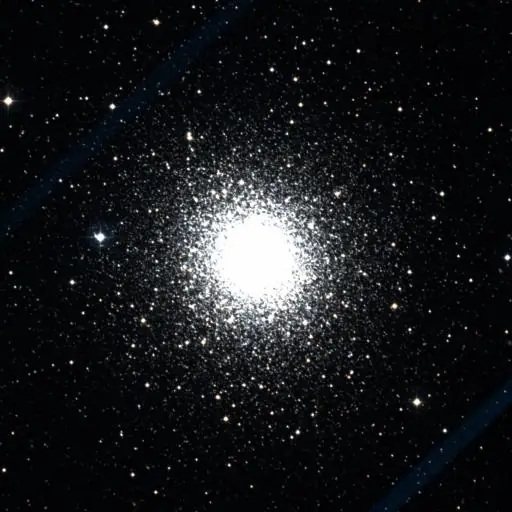
One of the oldest star clusters in our galaxy — and, 12,000 years ago, the northern sky’s pole cluster.
Some 11 billion years ago, when the Milky Way was young, a great ball of stars formed that still survives today. M 92 is one of the oldest globular clusters in our galaxy, with the mass of some 330,000 suns packed into it.
Its stars contain very little besides hydrogen and helium. Their iron content is only about half a percent of the Sun’s, a sign that they formed early, before generations of stars had enriched space with heavier elements.
Johann Elert Bode found the cluster on 27 December 1777. Charles Messier came across it again in March 1781, not knowing of Bode’s find, and gave it the number 92. In 1783 William Herschel became the first to resolve it into individual stars.
M 92 (NGC 6341) is 28,000 light-years away: the light we see from it set off about 28,000 years ago, when the last Ice Age was at its height, and mammoths roamed beneath the ice sheets.
Did you know?
- Once the pole cluster. As Earth’s axis slowly wobbles, the north celestial pole passes within a degree of M 92. About 12,000 years ago it was the northern sky’s ‘pole cluster’, and it will be again in roughly 14,000 years.
- Two generations. M 92 hosts at least two generations of stars. The second is slightly richer in helium, a sign that the cluster made stars more than once.
- Stars with a heartbeat. At least 17 RR Lyrae stars live in M 92. These old stars swell and shrink, brightening and fading over a cycle that lasts only hours.
How big is it?
About 270,000 Suns’ worth of stars in a ball 91 light-years wide. Light itself takes 91 years to cross it. That’s 22 times the distance from the Sun to the nearest star. In its core the stars are packed so tightly that each one’s nearest neighbour is about 8 light-days away. Our nearest neighbour, Proxima Centauri, is 4.2 light-years from the Sun — 206 times farther. To break free from its centre, a star would need 36 km/s — 3.3 times the speed a rocket needs to leave Earth. It will hold together for another 14 billion years or so — longer than the universe has existed. Shrink our Solar System — the Sun and all eight planets — to the size of a coin, and M 92 would be 2.3 km across (a 30-minute walk); the nearest star would be a football pitch away, and the Milky Way 2,520 km across.
A bright globular cluster in Hercules with a dense core, often overlooked in favor of M13 although it is nearly as impressive.
When and where to see it
It is best placed in the evening sky around July, when it crosses the meridian at about 10 pm local time (around midnight in June). It can be seen from everywhere north of 47°S and never sets north of 47°N.
At its highest it stands 83° up from 50°N, 82° up from 35°N, 47° up from the equator, 12° up from 35°S.
Facts
- Type
- Globular cluster
- Constellation
- Hercules
- Designations
- NGC 6341
- Magnitude
- 6.4
- Apparent size
- 11′
- Position
- RA 17h 17.1m, Dec +43° 8′ (J2000)
- Distance
- 28,000 light-years
- Discovered
- Johann Elert Bode, 1777
Open AstroPilot to see when M 92 (NGC 6341) is highest tonight from your location, how easy it is with your telescope or binoculars, and an eyepiece view.