M 9 (NGC 6333)
M 9 (NGC 6333) is a globular cluster in the constellation Ophiuchus, magnitude 7.7, 9.3′ across.
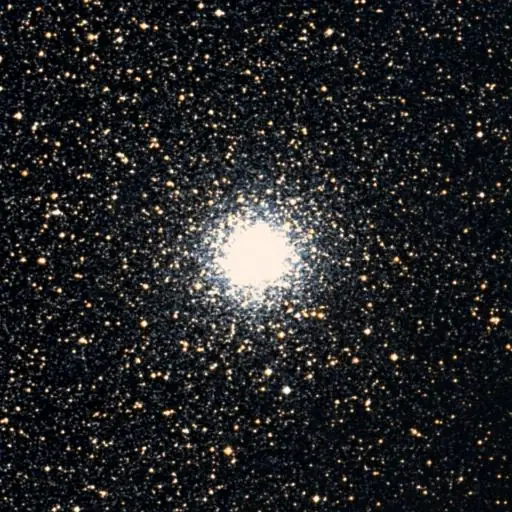
An ancient star ball close to the heart of the galaxy, set against a dark cloud of dust.
M 9 lives in a crowded neighbourhood. It is one of the globular clusters closest to the centre of the Milky Way, and it lies against a dark cloud of dust catalogued as Barnard 64. Altogether its stars shine with about 120,000 times the light of the Sun.
Charles Messier found it on 3 June 1764 and called it a “nebula without stars”. Nineteen years later William Herschel turned his reflector on it and resolved individual stars, packed more and more densely towards the middle.
M 9 (NGC 6333) is 27,000 light-years away: the light we see from it set off about 27,000 years ago, when the last Ice Age was at its height, and mammoths roamed beneath the ice sheets.
Did you know?
- Twenty-four variables. Astronomers have found 24 variable stars in M 9, including 21 RR Lyrae stars, a Type II Cepheid and an eclipsing binary — two stars that take turns hiding each other.
- No stragglers. Many globular clusters contain blue stragglers, stars that look too young for their cluster, made when stars merge or trade mass. None has been found in M 9.
How big is it?
About 310,000 Suns’ worth of stars in a ball 73 light-years wide. Light itself takes 73 years to cross it. That’s 17 times the distance from the Sun to the nearest star. In its core the stars are packed so tightly that each one’s nearest neighbour is about 44 light-days away. Our nearest neighbour, Proxima Centauri, is 4.2 light-years from the Sun — 35 times farther. To break free from its centre, a star would need 32 km/s — 2.9 times the speed a rocket needs to leave Earth. It will hold together for another 14 billion years or so — longer than the universe has existed. Shrink our Solar System — the Sun and all eight planets — to the size of a coin, and M 9 would be 1.84 km across (a 20-minute walk); the nearest star would be a football pitch away, and the Milky Way 2,520 km across.
A small, fairly concentrated globular cluster near the center of the Milky Way, dimmed and reddened by dust. Medium apertures begin to resolve its outer stars.
When and where to see it
It is best placed in the evening sky around July, when it crosses the meridian at about 10 pm local time (around midnight in June). It can be seen from everywhere south of 71°N and never sets south of 71°S.
At its highest it stands 21° up from 50°N, 36° up from 35°N, 71° up from the equator, 74° up from 35°S.
Facts
- Type
- Globular cluster
- Constellation
- Ophiuchus
- Designations
- NGC 6333
- Magnitude
- 7.7
- Apparent size
- 9.3′
- Position
- RA 17h 19.2m, Dec −18° 31′ (J2000)
- Distance
- 27,000 light-years
- Discovered
- Charles Messier, 1764
Open AstroPilot to see when M 9 (NGC 6333) is highest tonight from your location, how easy it is with your telescope or binoculars, and an eyepiece view.