Virgo A (M 87)
Virgo A (M 87) is a galaxy in the constellation Virgo, magnitude 8.6, 7.1′ × 6.7′ across.
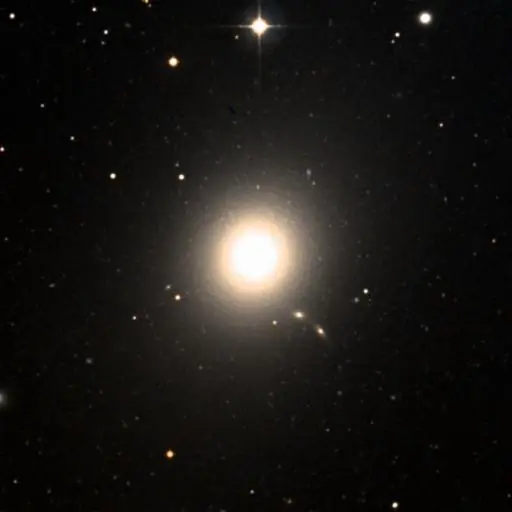
The galaxy whose black hole was the first ever photographed — a monster bigger than our whole planetary system.
On 10 April 2019 the world saw its first picture of a black hole: a ring of glowing gas around a dark shadow, at the heart of M 87. It took the Event Horizon Telescope — radio dishes across the Earth linked into one planet-sized telescope — to capture it, from data gathered in 2017. The black hole weighs about 6.5 billion suns, and its event horizon is wider than the orbits of all the planets around our Sun.
Long before that, M 87 kept surprising astronomers. Charles Messier logged it as a nebula in 1781. In 1918 Heber Curtis noticed a “curious straight ray” leading from its core — the first sighting of the jet of plasma that the black hole flings out at close to the speed of light. M 87 is a supergiant elliptical galaxy of several trillion stars, wrapped in about 15,000 globular clusters, against the Milky Way’s 150 to 200.
Virgo A (M 87) is 56 million light-years away: the light we see from it set off about 56 million years ago, when mammals were taking over a world without dinosaurs.
Did you know?
- A radio beacon. M 87 is one of the brightest radio sources in the sky, known as Virgo A. Rockets in the 1960s also found it to be the first X-ray source known in Virgo.
- Weighing the giant. In 1978 the motions of its stars pointed to a central mass of billions of suns. In 1993 the newly repaired Hubble Space Telescope weighed the black hole again from its swirling gas disc — one of its first tests after the repair.
- Seen by one man. Before 1991, Otto Struve was the only person known to have seen M 87’s jet with his own eyes, through the 100-inch Hooker telescope.
How big is it?
1.2 times as wide as our Milky Way. Light itself takes 120,000 years to cross it. Shrink it to the length of a football pitch and our whole Solar System would be smaller than a bacterium.
The giant elliptical at the center of the Virgo Cluster, surrounded by thousands of globular clusters; its central black hole was the first ever imaged (2019). Telescopes show a round glow with a bright core; its jet is a challenge for large apertures.
When and where to see it
It is best placed in the evening sky around April, when it crosses the meridian at about 10 pm local time (around midnight in March). It can be seen from everywhere north of 78°S and never sets north of 78°N.
At its highest it stands 52° up from 50°N, 67° up from 35°N, 78° up from the equator, 43° up from 35°S.
Facts
- Type
- Galaxy
- Constellation
- Virgo
- Designations
- M 87, NGC 4486, Virgo Galaxy
- Magnitude
- 8.6
- Apparent size
- 7.1′ × 6.7′
- Position
- RA 12h 30.8m, Dec +12° 23′ (J2000)
- Distance
- 56 million light-years
- Discovered
- Charles Messier, 1781
Open AstroPilot to see when Virgo A (M 87) is highest tonight from your location, how easy it is with your telescope or binoculars, and an eyepiece view.