M 79 (NGC 1904)
M 79 (NGC 1904) is a globular cluster in the constellation Lepus, magnitude 7.7, 8.7′ across.
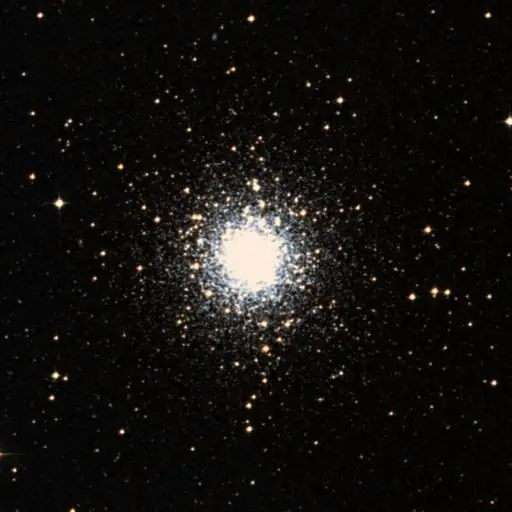
A globular cluster far from the galaxy’s heart — possibly a migrant from a disputed dwarf galaxy.
Most of the Milky Way’s globular clusters crowd towards the galactic centre, in Sagittarius, Scorpius and Ophiuchus. M 79, found by Pierre Méchain in 1780, sits in Lepus instead. Why is it out here?
One idea is that it is not one of ours at all. Like M 54, it may have arrived with a dwarf galaxy — in this case the Canis Major Dwarf Galaxy, which some astronomers think is having a close encounter with the Milky Way right now. Others doubt that galaxy exists at all, and M 79 may instead belong to the Gaia Sausage, the wreck of an older merger. Wherever it came from, the Milky Way is now pulling it apart: the cluster trails a long tidal tail of stars.
M 79 (NGC 1904) is 43,000 light-years away: the light we see from it set off about 43,000 years ago, when people were painting the oldest known cave art.
Did you know?
- Messier’s other immigrant. M 54 and M 79 are the two globular clusters in Messier’s list thought to have come from other galaxies.
- Red giants rule. Infrared images show that most of M 79’s brightest stars are red giants — old stars that have swollen up near the end of their lives.
How big is it?
About 180,000 Suns’ worth of stars in a ball 109 light-years wide. Light itself takes 109 years to cross it. That’s 26 times the distance from the Sun to the nearest star. In its core the stars are packed so tightly that each one’s nearest neighbour is about 29 light-days away. Our nearest neighbour, Proxima Centauri, is 4.2 light-years from the Sun — 54 times farther. To break free from its centre, a star would need 28 km/s — 2.5 times the speed a rocket needs to leave Earth. The Milky Way’s tides will pull it apart in about 2 billion years. Shrink our Solar System — the Sun and all eight planets — to the size of a coin, and M 79 would be 2.75 km across (a 35-minute walk); the nearest star would be a football pitch away, and the Milky Way 2,520 km across.
A compact globular cluster in Lepus, on the opposite side of the sky from the galactic center; it may have come from a dwarf galaxy absorbed by the Milky Way.
When and where to see it
It is best placed in the evening sky around January, when it crosses the meridian at about 10 pm local time (around midnight in December). It can be seen from everywhere south of 65°N and never sets south of 65°S.
At its highest it stands 15° up from 50°N, 30° up from 35°N, 65° up from the equator, 80° up from 35°S.
Facts
- Type
- Globular cluster
- Constellation
- Lepus
- Designations
- NGC 1904
- Magnitude
- 7.7
- Apparent size
- 8.7′
- Position
- RA 5h 24.2m, Dec −24° 31′ (J2000)
- Distance
- 43,000 light-years
- Discovered
- Pierre Méchain, 1780
Open AstroPilot to see when M 79 (NGC 1904) is highest tonight from your location, how easy it is with your telescope or binoculars, and an eyepiece view.