M 75 (NGC 6864)
M 75 (NGC 6864) is a globular cluster in the constellation Sagittarius, magnitude 8.5, 6.0′ across.
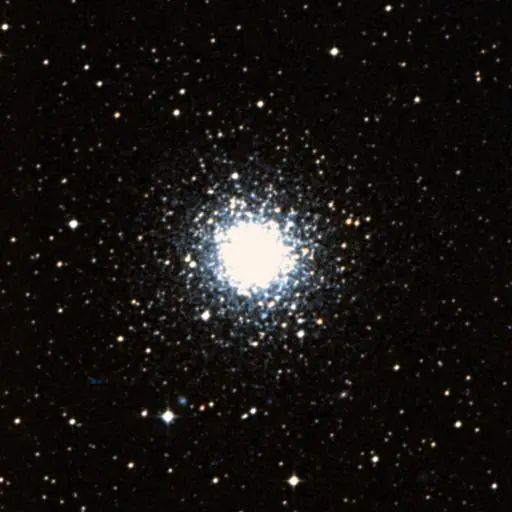
One of the most tightly packed globular clusters known — a refugee from a swallowed galaxy.
Neither Pierre Méchain, who spotted M 75 in Sagittarius in 1780, nor Charles Messier, who catalogued it the same year, could have guessed its story. It lies on the far side of the galaxy’s centre, and it is one of the most densely packed globular clusters known — class I on the scale astronomers use, the tightest category of all. Even so, its core has not yet collapsed.
It is probably an immigrant. M 75 belongs to the Gaia Sausage, thought to be the remains of a dwarf galaxy that merged with the Milky Way long ago. It still follows a wildly stretched orbit through the galaxy’s halo, completing a lap roughly every 400 million years.
M 75 (NGC 6864) is 67,000 light-years away: the light we see from it set off about 67,000 years ago, when our species still lived mostly in Africa.
Did you know?
- Rejuvenated stars. Astronomers have found 62 candidate blue stragglers here — stars that look too young for the cluster, probably made when two stars merged. Most of them crowd into the dense core.
- Bright as 180,000 suns. Together its stars shine about 180,000 times brighter than the Sun, and the whole cluster turns slowly on its axis.
How big is it?
About 460,000 Suns’ worth of stars in a ball 117 light-years wide. Light itself takes 117 years to cross it. That’s 28 times the distance from the Sun to the nearest star. In its core the stars are packed so tightly that each one’s nearest neighbour is about 21 light-days away. Our nearest neighbour, Proxima Centauri, is 4.2 light-years from the Sun — 74 times farther. To break free from its centre, a star would need 48 km/s — 4.3 times the speed a rocket needs to leave Earth. It will hold together for another 21 billion years or so — longer than the universe has existed. Shrink our Solar System — the Sun and all eight planets — to the size of a coin, and M 75 would be 2.95 km across (a 35-minute walk); the nearest star would be a football pitch away, and the Milky Way 2,520 km across.
A small, very concentrated globular cluster about 68,000 light-years away, one of the more remote Messier globulars.
When and where to see it
It is best placed in the evening sky around August, when it crosses the meridian at about 10 pm local time (around midnight in July). It can be seen from everywhere south of 68°N and never sets south of 68°S.
At its highest it stands 18° up from 50°N, 33° up from 35°N, 68° up from the equator, 77° up from 35°S.
Facts
- Type
- Globular cluster
- Constellation
- Sagittarius
- Designations
- NGC 6864
- Magnitude
- 8.5
- Apparent size
- 6.0′
- Position
- RA 20h 6.1m, Dec −21° 55′ (J2000)
- Distance
- 67,000 light-years
- Discovered
- Pierre Méchain, 1780
Open AstroPilot to see when M 75 (NGC 6864) is highest tonight from your location, how easy it is with your telescope or binoculars, and an eyepiece view.