M 72 (NGC 6981)
M 72 (NGC 6981) is a globular cluster in the constellation Aquarius, magnitude 9.3, 5.9′ across.
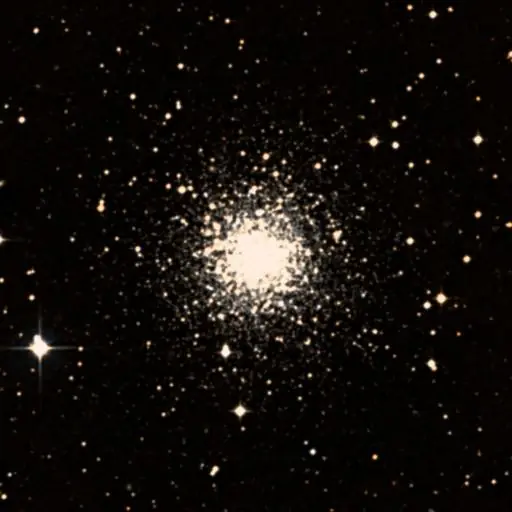
Messier and Méchain saw only a faint nebula — it took John Herschel to see the stars.
Two great comet hunters looked at M 72 and saw only a faint nebula. Pierre Méchain found it on 29 August 1780, and his countryman Charles Messier tracked it down 36 days later and added it to the catalogue. It took John Herschel’s larger telescope to show it for what it is: a “cluster of stars of a round figure”. Harlow Shapley later noted its likeness to two other globulars, M 4 and M 12.
M 72 is a globular cluster of about 168,000 suns’ worth of stars. They are around 9.5 billion years old, more than twice the age of our Sun.
M 72 (NGC 6981) is 54,000 light-years away: the light we see from it set off about 54,000 years ago, when people were painting the oldest known cave art.
Did you know?
- Measured by its heartbeats. M 72 has 43 known variable stars. A 2011 census of them was used to work out how far away the cluster lies.
- Older than the Sun, twice over. When M 72’s stars were already more than four billion years old, the cloud that would form our Sun and Earth had not yet collapsed.
How big is it?
About 81,000 Suns’ worth of stars in a ball 93 light-years wide. Light itself takes 93 years to cross it. That’s 22 times the distance from the Sun to the nearest star. In its core the stars are packed so tightly that each one’s nearest neighbour is about 5 light-months away. Our nearest neighbour, Proxima Centauri, is 4.2 light-years from the Sun — 10 times farther. To break free from its centre, a star would need 12 km/s — about the speed a rocket needs to leave Earth. The Milky Way’s tides will pull it apart in about 2.8 billion years. Shrink our Solar System — the Sun and all eight planets — to the size of a coin, and M 72 would be 2.34 km across (a 30-minute walk); the nearest star would be a football pitch away, and the Milky Way 2,520 km across.
A faint, remote globular cluster in Aquarius, about 55,000 light-years away, appearing as a small, round fuzzy patch.
When and where to see it
It is best placed in the evening sky around September, when it crosses the meridian at about 10 pm local time (around midnight in August). It can be seen from everywhere south of 77°N and never sets south of 77°S.
At its highest it stands 27° up from 50°N, 42° up from 35°N, 77° up from the equator, 68° up from 35°S.
Facts
- Type
- Globular cluster
- Constellation
- Aquarius
- Designations
- NGC 6981
- Magnitude
- 9.3
- Apparent size
- 5.9′
- Position
- RA 20h 53.5m, Dec −12° 32′ (J2000)
- Distance
- 54,000 light-years
- Discovered
- Pierre Méchain, 1780
Open AstroPilot to see when M 72 (NGC 6981) is highest tonight from your location, how easy it is with your telescope or binoculars, and an eyepiece view.