M 71 (NGC 6838)
M 71 (NGC 6838) is a globular cluster in the constellation Sagitta, magnitude 8.2, 7.2′ across.
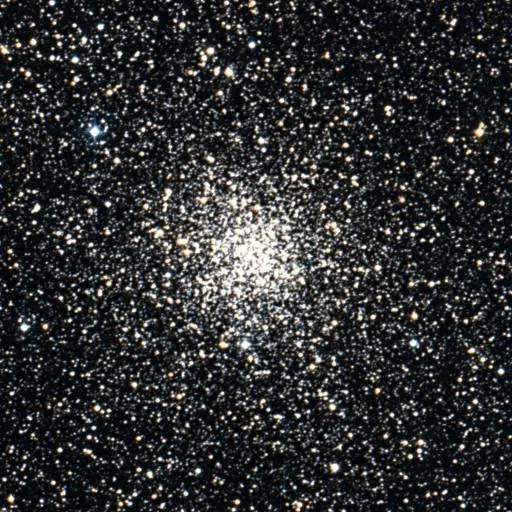
A globular cluster that spent decades disguised as an open cluster.
The Swiss astronomer Philippe Loys de Chéseaux found this cluster in Sagitta in 1745. Johann Gottfried Koehler noted it at Dresden around 1775, and Charles Messier added it to his catalogue in 1780. Then came a long identity crisis.
For much of the 20th century M 71 was filed as a densely packed open cluster. It looked wrong for a globular: no tightly packed centre, more heavy elements than usual, and none of the RR Lyrae stars that most globulars contain. Only in the 1970s did it switch sides. Careful measurements of its stars revealed a short “horizontal branch” on their colour–brightness chart — a fingerprint of a globular cluster. The branch is short because M 71 is young for a globular, at 9–10 billion years.
M 71 (NGC 6838) is 13,000 light-years away: the light we see from it set off about 13,000 years ago, when the last Ice Age was ending.
Did you know?
- A lightweight. M 71 weighs about 53,000 suns and shines with the light of around 19,000 — modest for a globular cluster, many of which hold a few hundred thousand suns’ worth of stars.
- A restless member. The irregular variable star Z Sagittae belongs to the cluster, its brightness rising and falling without a steady rhythm.
How big is it?
About 38,000 Suns’ worth of stars in a ball 27 light-years wide. Light itself takes 27 years to cross it. That’s 6.4 times the distance from the Sun to the nearest star. In its core the stars are packed so tightly that each one’s nearest neighbour is about 4 light-months away. Our nearest neighbour, Proxima Centauri, is 4.2 light-years from the Sun — 13 times farther. To break free from its centre, a star would need 10 km/s — about the speed a rocket needs to leave Earth. The Milky Way’s tides will pull it apart in about 7.8 billion years. Shrink our Solar System — the Sun and all eight planets — to the size of a coin, and M 71 would be 687 m across (7 football pitches end to end); the nearest star would be a football pitch away, and the Milky Way 2,520 km across.
A loose, faint globular cluster in Sagitta that was long classed as an open cluster; small telescopes resolve it easily.
When and where to see it
It is best placed in the evening sky around August, when it crosses the meridian at about 10 pm local time (around midnight in July). It can be seen from everywhere north of 71°S and never sets north of 71°N.
At its highest it stands 59° up from 50°N, 74° up from 35°N, 71° up from the equator, 36° up from 35°S.
Facts
- Type
- Globular cluster
- Constellation
- Sagitta
- Designations
- NGC 6838, NGC 6839, Angelfish Cluster
- Magnitude
- 8.2
- Apparent size
- 7.2′
- Position
- RA 19h 53.8m, Dec +18° 47′ (J2000)
- Distance
- 13,000 light-years
- Discovered
- Philippe Loys de Chéseaux, 1745, Koehler saw it around 1775; Messier catalogued it in 1780
Open AstroPilot to see when M 71 (NGC 6838) is highest tonight from your location, how easy it is with your telescope or binoculars, and an eyepiece view.