M 70 (NGC 6681)
M 70 (NGC 6681) is a globular cluster in the constellation Sagittarius, magnitude 7.9, 7.8′ across.
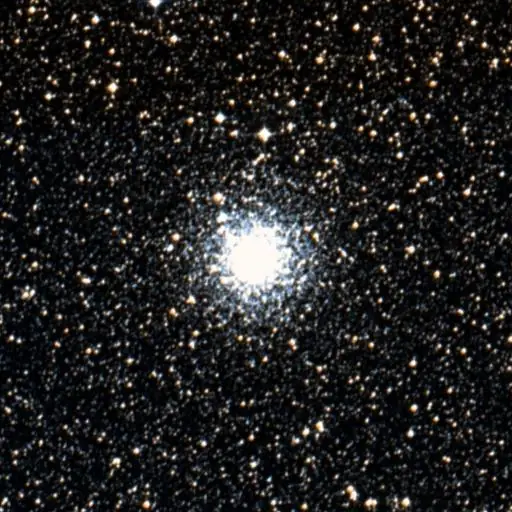
The cluster two observers were looking at in 1995 when a great comet drifted into view.
On a July night in 1995, two observers in different states — Alan Hale in New Mexico and Thomas Bopp in Arizona — each turned a telescope towards this small globular cluster. Each noticed a fuzzy spot beside it that did not belong. It was a comet, and it grew into Hale–Bopp, the Great Comet of 1997, visible to the naked eye for about a year and a half.
M 70 itself was found by Charles Messier in 1780, on the same night as M 69. The two are close in space as well as on the sky, near-twins in size and brightness. M 70’s heart has undergone core collapse: its stars have crowded into a tiny, dense centre, a state reached by only some globular clusters.
M 70 (NGC 6681) is 31,000 light-years away: the light we see from it set off about 31,000 years ago, when people were painting the oldest known cave art.
Did you know?
- Two generations. M 70’s stars fall into two groups with different chemical mixes — probably two generations, the younger born from gas enriched by the older.
- Rejuvenated stars?. Two possible blue stragglers sit near the core — stars that look too young for the cluster, probably made when two stars merged.
How big is it?
About 100,000 Suns’ worth of stars in a ball 70 light-years wide. Light itself takes 70 years to cross it. That’s 17 times the distance from the Sun to the nearest star. In its core the stars are packed so tightly that each one’s nearest neighbour is about 9 light-days away. Our nearest neighbour, Proxima Centauri, is 4.2 light-years from the Sun — 168 times farther. To break free from its centre, a star would need 25 km/s — 2.3 times the speed a rocket needs to leave Earth. The Milky Way’s tides will pull it apart in about 3.4 billion years. Shrink our Solar System — the Sun and all eight planets — to the size of a coin, and M 70 would be 1.78 km across (a 20-minute walk); the nearest star would be a football pitch away, and the Milky Way 2,520 km across.
A small, dense globular cluster near the Teapot's base whose core has collapsed, 2.5° east of M69. Comet Hale–Bopp was discovered next to it in 1995.
When and where to see it
It is best placed in the evening sky around August, when it crosses the meridian at about 10 pm local time (around midnight in July). It can be seen from everywhere south of 58°N and never sets south of 58°S.
At its highest it stands 8° up from 50°N, 23° up from 35°N, 58° up from the equator, 87° up from 35°S.
Facts
- Type
- Globular cluster
- Constellation
- Sagittarius
- Designations
- NGC 6681
- Magnitude
- 7.9
- Apparent size
- 7.8′
- Position
- RA 18h 43.2m, Dec −32° 18′ (J2000)
- Distance
- 31,000 light-years
- Discovered
- Charles Messier, 1780
Open AstroPilot to see when M 70 (NGC 6681) is highest tonight from your location, how easy it is with your telescope or binoculars, and an eyepiece view.