M 68 (NGC 4590)
M 68 (NGC 4590) is a globular cluster in the constellation Hydra, magnitude 7.8, 12′ across.
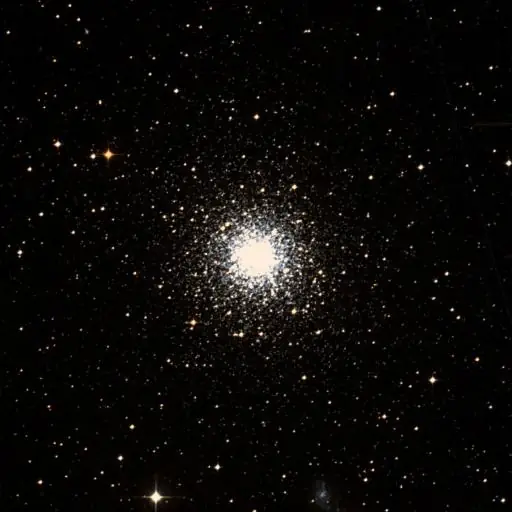
A pristine ball of ancient stars on a long, looping orbit — probably captured from another galaxy.
Father and son saw M 68 rather differently. Charles Messier had found it in 1780; later, William Herschel’s larger telescope showed “a beautiful cluster of stars, extremely rich”, so compressed that most of them blended together. His son John was less romantic, calling it “very loose and ragged at the borders”.
This globular cluster is one of the most metal-poor known: its stars are almost pure hydrogen and helium, made from gas that earlier generations of stars had barely enriched. It swings around the Milky Way’s central bulge on a stretched, oval orbit that carries it far out into the halo. Astronomers suspect it was not born here at all, but captured from a small satellite galaxy. It may be undergoing core collapse, and it shows signs of slowly rotating.
M 68 (NGC 4590) is 34,000 light-years away: the light we see from it set off about 34,000 years ago, when people were painting the oldest known cave art.
Did you know?
- Shapley’s variables. Harlow Shapley identified M 68’s first 28 variable stars in 1919–20. Today about 50 are known — mostly RR Lyrae stars, plus six SX Phoenicis stars that pulse rapidly.
- A long way round. M 68’s orbit is so elongated that it spends much of its time far from the galaxy’s centre, out among the thinly scattered stars of the halo.
How big is it?
About 130,000 Suns’ worth of stars in a ball 119 light-years wide. Light itself takes 119 years to cross it. That’s 28 times the distance from the Sun to the nearest star. In its core the stars are packed so tightly that each one’s nearest neighbour is about 4 light-months away. Our nearest neighbour, Proxima Centauri, is 4.2 light-years from the Sun — 12 times farther. To break free from its centre, a star would need 15 km/s — 1.3 times the speed a rocket needs to leave Earth. It will hold together for another 55 billion years or so — longer than the universe has existed. Shrink our Solar System — the Sun and all eight planets — to the size of a coin, and M 68 would be 3 km across (a 35-minute walk); the nearest star would be a football pitch away, and the Milky Way 2,520 km across.
A globular cluster in Hydra, low for northern observers; medium telescopes resolve its outer stars around a moderately concentrated core.
When and where to see it
It is best placed in the evening sky around May, when it crosses the meridian at about 10 pm local time (around midnight in March). It can be seen from everywhere south of 63°N and never sets south of 63°S.
At its highest it stands 13° up from 50°N, 28° up from 35°N, 63° up from the equator, 82° up from 35°S.
Facts
- Type
- Globular cluster
- Constellation
- Hydra
- Designations
- NGC 4590
- Magnitude
- 7.8
- Apparent size
- 12′
- Position
- RA 12h 39.5m, Dec −26° 45′ (J2000)
- Distance
- 34,000 light-years
- Discovered
- Charles Messier, 1780
Open AstroPilot to see when M 68 (NGC 4590) is highest tonight from your location, how easy it is with your telescope or binoculars, and an eyepiece view.