M 55 (NGC 6809)
M 55 (NGC 6809) is a globular cluster in the constellation Sagittarius, magnitude 6.3, 19′ across.
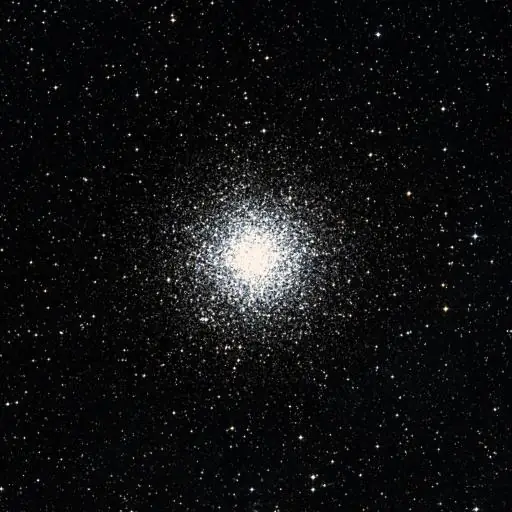
Found from the southern tip of Africa, then chased by Messier from Paris for more than twenty years.
In 1752 the French astronomer Nicolas Louis de Lacaille was charting the southern sky from the Cape, in what is now South Africa, when he came across this ghostly ball of stars. Back in Paris, Charles Messier tried to find it from 1754 onwards, but from there it barely clears the horizon. Only in 1778 did he finally catch it and add it to his catalogue.
M 55 is a globular cluster holding around 269,000 suns’ worth of stars. Like other globulars it is very old, and its stars are almost pure hydrogen and helium: they contain only about 1% of the Sun’s share of iron. About 55 variable stars have been found in its central part.
M 55 (NGC 6809) is 17,000 light-years away: the light we see from it set off about 17,000 years ago, when the last Ice Age was at its height, and mammoths roamed beneath the ice sheets.
Did you know?
- A time capsule. With so few heavy elements, M 55’s stars preserve the chemistry of the young Milky Way, from before generations of exploding stars had enriched the gas.
- The man who named the south. Lacaille, who found M 55, also gave the southern sky 14 of its modern constellations, including Telescopium, Microscopium and Fornax.
How big is it?
About 200,000 Suns’ worth of stars in a ball 94 light-years wide. Light itself takes 94 years to cross it. That’s 22 times the distance from the Sun to the nearest star. In its core the stars are packed so tightly that each one’s nearest neighbour is about 4 light-months away. Our nearest neighbour, Proxima Centauri, is 4.2 light-years from the Sun — 12 times farther. To break free from its centre, a star would need 18 km/s — 1.6 times the speed a rocket needs to leave Earth. The Milky Way’s tides will pull it apart in about 12 billion years. Shrink our Solar System — the Sun and all eight planets — to the size of a coin, and M 55 would be 2.37 km across (a 30-minute walk); the nearest star would be a football pitch away, and the Milky Way 2,520 km across.
A large, loose globular cluster low in Sagittarius; its sparse core makes it easy to resolve in small telescopes.
When and where to see it
It is best placed in the evening sky around August, when it crosses the meridian at about 10 pm local time (around midnight in July). It can be seen from everywhere south of 59°N and never sets south of 59°S.
At its highest it stands 9° up from 50°N, 24° up from 35°N, 59° up from the equator, 86° up from 35°S.
Facts
- Type
- Globular cluster
- Constellation
- Sagittarius
- Designations
- NGC 6809, Specter Cluster
- Magnitude
- 6.3
- Apparent size
- 19′
- Position
- RA 19h 40.0m, Dec −30° 58′ (J2000)
- Distance
- 17,000 light-years
- Discovered
- Nicolas Louis de Lacaille, 1752, Messier catalogued it in 1778
Open AstroPilot to see when M 55 (NGC 6809) is highest tonight from your location, how easy it is with your telescope or binoculars, and an eyepiece view.