M 54 (NGC 6715)
M 54 (NGC 6715) is a globular cluster in the constellation Sagittarius, magnitude 7.6, 9.1′ across.
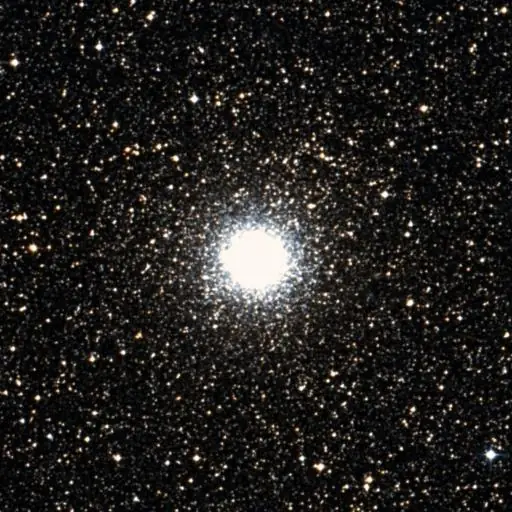
A globular cluster from another galaxy — possibly the very heart of a dwarf galaxy the Milky Way is swallowing.
When Charles Messier recorded M 54 in 1778, he naturally took it for one of the Milky Way’s own globular clusters, and so did everyone else for more than two centuries. Then, in 1994, astronomers discovered the Sagittarius Dwarf Elliptical Galaxy, a small galaxy hidden behind the crowded star fields of Sagittarius — and M 54 sits at its centre.
That made M 54 the first globular once counted as ours to be reassigned to another galaxy. Some astronomers think it may actually be that dwarf galaxy’s core; others think it is an ordinary globular that sank to the middle as its orbit decayed. Either way, it is a heavyweight, shining with the light of about 850,000 suns.
M 54 (NGC 6715) is 86,000 light-years away: the light we see from it set off about 86,000 years ago, when our species still lived mostly in Africa.
Did you know?
- A middleweight black hole?. In 2009 a team reported evidence for an intermediate-mass black hole in M 54’s core — the elusive in-between kind, heavier than those left by single stars but far lighter than galaxy-centre giants.
- Ours after all, one day. The Sagittarius dwarf galaxy is being torn apart by the Milky Way’s gravity. In time, its stars and its clusters — M 54 included — may become part of our galaxy.
- Tightly packed. On the scale astronomers use to rank how densely globulars are packed, from I (densest) to XII (loosest), M 54 rates III — one of the denser ones.
How big is it?
About 1.6 million Suns’ worth of stars in a ball 228 light-years wide. Light itself takes 228 years to cross it. That’s 54 times the distance from the Sun to the nearest star. In its core the stars are packed so tightly that each one’s nearest neighbour is about 18 light-days away. Our nearest neighbour, Proxima Centauri, is 4.2 light-years from the Sun — 87 times farther. To break free from its centre, a star would need 69 km/s — 6.2 times the speed a rocket needs to leave Earth. It will hold together for another 614 billion years or so — longer than the universe has existed. Shrink our Solar System — the Sun and all eight planets — to the size of a coin, and M 54 would be 5.75 km across (an hour’s walk); the nearest star would be a football pitch away, and the Milky Way 2,520 km across.
A small, bright globular cluster about 87,000 light-years away that belongs to the Sagittarius Dwarf Galaxy, not to the Milky Way — so Messier's 1778 discovery was, unknowingly, the first globular cluster found in another galaxy.
When and where to see it
It is best placed in the evening sky around August, when it crosses the meridian at about 10 pm local time (around midnight in July). It can be seen from everywhere south of 60°N and never sets south of 60°S.
At its highest it stands 10° up from 50°N, 25° up from 35°N, 60° up from the equator, 85° up from 35°S.
Facts
- Type
- Globular cluster
- Constellation
- Sagittarius
- Designations
- NGC 6715
- Magnitude
- 7.6
- Apparent size
- 9.1′
- Position
- RA 18h 55.1m, Dec −30° 29′ (J2000)
- Distance
- 86,000 light-years
- Discovered
- Charles Messier, 1778
Open AstroPilot to see when M 54 (NGC 6715) is highest tonight from your location, how easy it is with your telescope or binoculars, and an eyepiece view.