M 53 (NGC 5024)
M 53 (NGC 5024) is a globular cluster in the constellation Coma Berenices, magnitude 7.6, 13′ across.
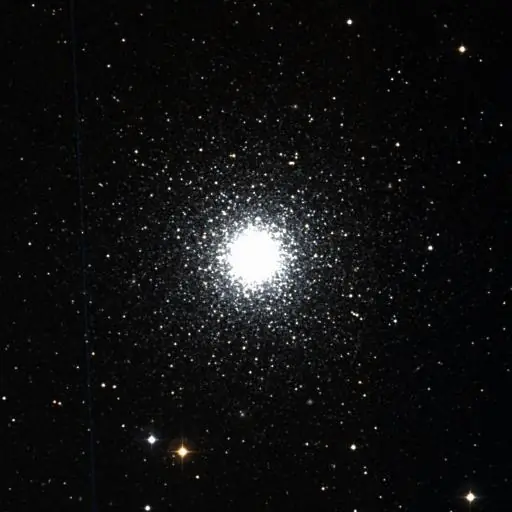
A globular cluster of first-generation stars — perhaps joined to its neighbour by a bridge of stars.
Johann Elert Bode, the Berlin astronomer, found this globular cluster in 1775, and Charles Messier later made it number 53 in his catalogue. It turned out to be an unusual one. In most globulars, the majority of stars are a second generation, formed from gas enriched by an earlier round of stars. In M 53 most of the red giants belong to the very first generation. Its stars are also very poor in heavy elements; at one time it was thought to be the most metal-poor cluster in the Milky Way.
M 53 may have a strange relationship with its neighbour NGC 5053. A faint bridge of stars seems to link the two, wrapped in a shared envelope — signs of a tidal tussle that may be unique in our galaxy. M 53 is also a candidate member of the Sagittarius stream, a river of stars torn from a dwarf galaxy.
M 53 (NGC 5024) is 60,000 light-years away: the light we see from it set off about 60,000 years ago, when our species still lived mostly in Africa.
Did you know?
- Fraying at the edges. Clumps, ripples and long tails of stars stretch east and west along M 53’s orbit, pulled out by the Milky Way’s gravity.
- Clockwork stars. M 53 holds 55 RR Lyrae stars, which brighten and dim on a regular beat. Their steady rhythm makes them handy yardsticks for measuring cosmic distances.
How big is it?
About 500,000 Suns’ worth of stars in a ball 220 light-years wide. Light itself takes 220 years to cross it. That’s 52 times the distance from the Sun to the nearest star. In its core the stars are packed so tightly that each one’s nearest neighbour is about 3 light-months away. Our nearest neighbour, Proxima Centauri, is 4.2 light-years from the Sun — 18 times farther. To break free from its centre, a star would need 26 km/s — 2.3 times the speed a rocket needs to leave Earth. It will hold together for another 150 billion years or so — longer than the universe has existed. Shrink our Solar System — the Sun and all eight planets — to the size of a coin, and M 53 would be 5.55 km across (an hour’s walk); the nearest star would be a football pitch away, and the Milky Way 2,520 km across.
A compact globular cluster in Coma Berenices, one of the more remote in the Messier list at about 60,000 light-years. The faint, loose globular NGC 5053 lies 1° to its southeast.
When and where to see it
It is best placed in the evening sky around May, when it crosses the meridian at about 10 pm local time (around midnight in April). It can be seen from everywhere north of 72°S and never sets north of 72°N.
At its highest it stands 58° up from 50°N, 73° up from 35°N, 72° up from the equator, 37° up from 35°S.
Facts
- Type
- Globular cluster
- Constellation
- Coma Berenices
- Designations
- NGC 5024
- Magnitude
- 7.6
- Apparent size
- 13′
- Position
- RA 13h 12.9m, Dec +18° 10′ (J2000)
- Distance
- 60,000 light-years
- Discovered
- Johann Elert Bode, 1775
Open AstroPilot to see when M 53 (NGC 5024) is highest tonight from your location, how easy it is with your telescope or binoculars, and an eyepiece view.