M 5 (NGC 5904)
M 5 (NGC 5904) is a globular cluster in the constellation Serpens, magnitude 5.7, 17′ across.
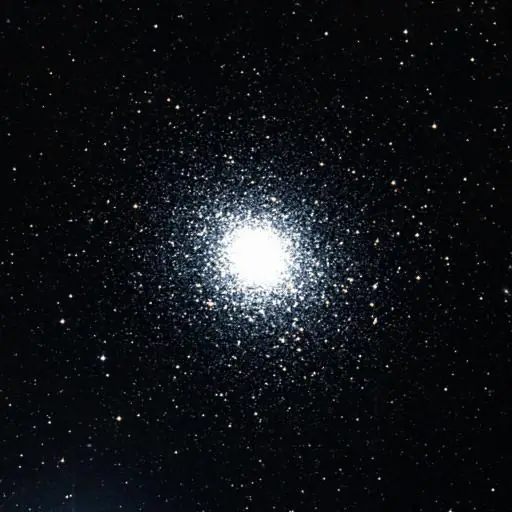
A comet hunter’s chance find from 1702 — now a laboratory for pulsing stars, pulsars and neutrinos.
In 1702 the German astronomer Gottfried Kirch was following a comet when he noticed a faint, fuzzy “star” nearby. He had found M 5, one of the grandest globular clusters in the sky. Charles Messier logged it in 1764 as one of his nebulae. It took William Herschel, in 1791, to split it into stars — he counted roughly 200.
M 5 is now known to hold 105 variable stars, 97 of them RR Lyrae stars. Because their rhythm is tied to their true brightness, these pulsing stars serve as cosmic measuring sticks. The whole cluster is also rushing away from us at more than 50 kilometres per second.
M 5 (NGC 5904) is 24,000 light-years away: the light we see from it set off about 24,000 years ago, when the last Ice Age was at its height, and mammoths roamed beneath the ice sheets.
Did you know?
- Weighing a neutron star. M 5 holds two millisecond pulsars, one of them in a binary. If its measured mass is confirmed, it would rule out some theories of how matter behaves inside neutron stars.
- A neutrino test lab. Astronomers have used M 5’s stars to test whether neutrinos carry a tiny magnetic moment — a search that could shed light on hypothetical particles such as the axion.
- A star that flares. A dwarf nova has been seen in M 5: a white dwarf pulling gas from a close companion and erupting in sudden outbursts.
How big is it?
About 390,000 Suns’ worth of stars in a ball 121 light-years wide. Light itself takes 121 years to cross it. That’s 29 times the distance from the Sun to the nearest star. In its core the stars are packed so tightly that each one’s nearest neighbour is about 57 light-days away. Our nearest neighbour, Proxima Centauri, is 4.2 light-years from the Sun — 27 times farther. To break free from its centre, a star would need 30 km/s — 2.7 times the speed a rocket needs to leave Earth. It will hold together for another 53 billion years or so — longer than the universe has existed. Shrink our Solar System — the Sun and all eight planets — to the size of a coin, and M 5 would be 3.07 km across (a 35-minute walk); the nearest star would be a football pitch away, and the Milky Way 2,520 km across.
A large, bright globular cluster that rivals M13, easy in binoculars with the star 5 Serpentis just to its south-southeast. Medium apertures resolve a dense core surrounded by long arcs of stars.
When and where to see it
It is best placed in the evening sky around June, when it crosses the meridian at about 10 pm local time (around midnight in May). It can be seen from everywhere north of 88°S and never sets north of 88°N.
At its highest it stands 42° up from 50°N, 57° up from 35°N, 88° up from the equator, 53° up from 35°S.
Facts
- Type
- Globular cluster
- Constellation
- Serpens
- Designations
- NGC 5904, Rose Cluster
- Magnitude
- 5.7
- Apparent size
- 17′
- Position
- RA 15h 18.6m, Dec +2° 5′ (J2000)
- Distance
- 24,000 light-years
- Discovered
- Gottfried Kirch, 1702
Open AstroPilot to see when M 5 (NGC 5904) is highest tonight from your location, how easy it is with your telescope or binoculars, and an eyepiece view.