M 49 (NGC 4472)
M 49 (NGC 4472) is a galaxy in the constellation Virgo, magnitude 8.4, 10′ × 8.4′ across.
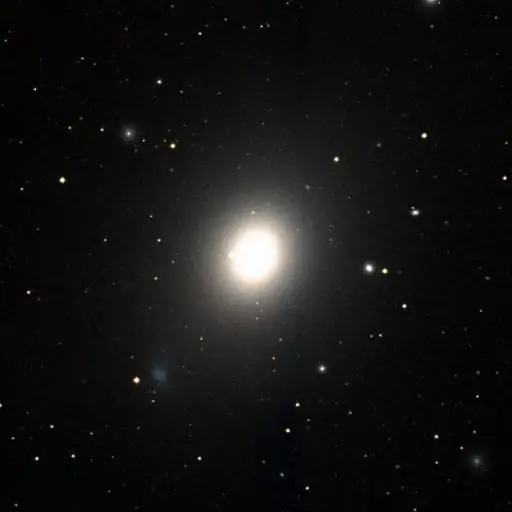
The first galaxy ever found in the Virgo Cluster — and still the most luminous of them all.
In 1771 Charles Messier, combing the sky for comets, logged a faint round glow in Virgo. Without knowing it he had found the first member of the Virgo Cluster, a vast swarm of galaxies. M 49 turned out to be its most luminous member — and brighter, in true output, than any galaxy closer to us.
This giant elliptical is a city of old stars. Its centre hides a black hole of about 565 million suns, and around it swarm some 5,900 globular clusters — nearly thirty times as many as the Milky Way has. On average they are about 10 billion years old. Inside one of them, astronomers found strong evidence for a black hole of its own.
M 49 (NGC 4472) is 56 million light-years away: the light we see from it set off about 56 million years ago, when mammals were taking over a world without dinosaurs.
Did you know?
- A dwarf in its grip. M 49 is pulling on a small irregular galaxy, UGC 7636, which now trails a long stream of debris behind it.
- Ploughing through the cluster. X-ray images show a structure to the north of M 49 that looks like a bow shock — as if the galaxy were pushing through the Virgo Cluster’s hot gas.
- Seen by Rubin. A supernova, SN 2024kce, flared in M 49’s outskirts in 2024 — possibly a rare calcium-rich type. It was still visible in June 2025 when the new Vera C. Rubin Observatory imaged the area.
How big is it?
1.7 times as wide as our Milky Way. Light itself takes 170,000 years to cross it. Shrink it to the length of a football pitch and our whole Solar System would be smaller than a bacterium.
The brightest galaxy of the Virgo Cluster, a giant elliptical that shows as a bright oval glow with a star-like core.
When and where to see it
It is best placed in the evening sky around April, when it crosses the meridian at about 10 pm local time (around midnight in March). It can be seen from everywhere north of 82°S and never sets north of 82°N.
At its highest it stands 48° up from 50°N, 63° up from 35°N, 82° up from the equator, 47° up from 35°S.
Facts
- Type
- Galaxy
- Constellation
- Virgo
- Designations
- NGC 4472
- Magnitude
- 8.4
- Apparent size
- 10′ × 8.4′
- Position
- RA 12h 29.8m, Dec +8° 0′ (J2000)
- Distance
- 56 million light-years
- Discovered
- Charles Messier, 1771
Open AstroPilot to see when M 49 (NGC 4472) is highest tonight from your location, how easy it is with your telescope or binoculars, and an eyepiece view.