M 4 (NGC 6121)
M 4 (NGC 6121) is a globular cluster in the constellation Scorpius, magnitude 5.6, 26′ across.
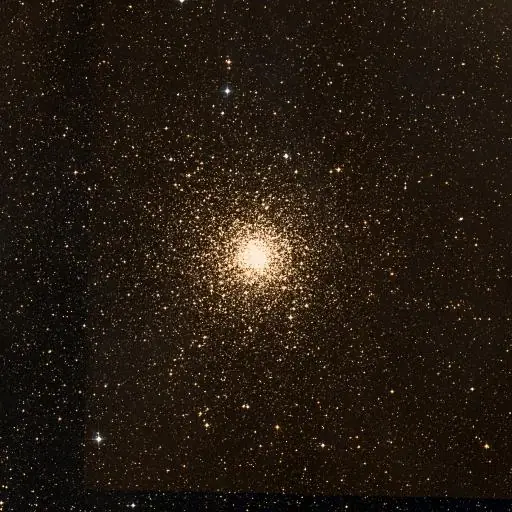
The nearest globular cluster — home to some of the oldest stars and one of the oldest planets known.
Some of the oldest stars in the Milky Way live here. In 1995 the Hubble Space Telescope picked out white dwarfs in M 4 — the cooling cores of dead suns — estimated at around 13 billion years old. M 4 is the nearest globular cluster to the Solar System, which makes such faint, ancient stars easier to study.
Its path around the galaxy is a wild one. Every 116 million years or so, M 4 dives in close to the galactic centre and then swings far back out, punching through the Milky Way’s disc on the way. Each passage shakes the cluster and strips away stars, so it may once have been much more massive.
Philippe Loys de Chéseaux discovered it in 1745, and Charles Messier catalogued it in 1764. M 4 was the first globular cluster in which individual stars were seen.
M 4 (NGC 6121) is 6,000 light-years away: the light we see from it set off around 3980 BC, 770 years before writing was invented in Mesopotamia.
Did you know?
- Methuselah’s home. One of M 4’s pulsars has a white dwarf partner, and a planet about 2.5 times Jupiter’s mass circles them both. Nicknamed Methuselah, it is one of the oldest planets known.
- A hidden black hole?. In 2023, Hubble and Gaia data revealed about 800 Suns’ worth of unseen mass packed into M 4’s centre — possible evidence of a middleweight black hole, though a tight swarm of dead stars can’t be ruled out.
- Sparks in the eyepiece. Robert Burnham Jr. compared the telescopic view of M 4 to a spinthariscope, a device that shows tiny flashes of light as radioactive particles strike a screen.
How big is it?
About 90,000 Suns’ worth of stars in a ball 46 light-years wide. Light itself takes 46 years to cross it. That’s 11 times the distance from the Sun to the nearest star. In its core the stars are packed so tightly that each one’s nearest neighbour is about 44 light-days away. Our nearest neighbour, Proxima Centauri, is 4.2 light-years from the Sun — 35 times farther. To break free from its centre, a star would need 19 km/s — 1.7 times the speed a rocket needs to leave Earth. The Milky Way’s tides will pull it apart in about 2.3 billion years. Shrink our Solar System — the Sun and all eight planets — to the size of a coin, and M 4 would be 1.16 km across (a 15-minute walk); the nearest star would be a football pitch away, and the Milky Way 2,520 km across.
One of the nearest globular clusters, about 6,000 light-years away, and among the easiest to resolve: small telescopes show individual stars and a bar of stars across its center. It lies just west of Antares.
When and where to see it
It is best placed in the evening sky around June, when it crosses the meridian at about 10 pm local time (around midnight in May). It can be seen from everywhere south of 63°N and never sets south of 63°S.
At its highest it stands 13° up from 50°N, 28° up from 35°N, 63° up from the equator, 82° up from 35°S.
Facts
- Type
- Globular cluster
- Constellation
- Scorpius
- Designations
- NGC 6121, Spider Globular Cluster
- Magnitude
- 5.6
- Apparent size
- 26′
- Position
- RA 16h 23.6m, Dec −26° 32′ (J2000)
- Distance
- 6,000 light-years
- Discovered
- Philippe Loys de Chéseaux, 1745
Open AstroPilot to see when M 4 (NGC 6121) is highest tonight from your location, how easy it is with your telescope or binoculars, and an eyepiece view.