M 30 (NGC 7099)
M 30 (NGC 7099) is a globular cluster in the constellation Capricornus, magnitude 7.2, 11′ across.
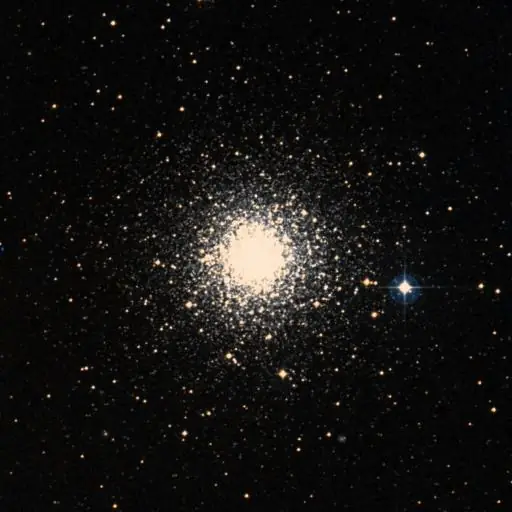
An ancient cluster swimming against the galactic current — probably adopted from another galaxy.
Most of the Milky Way turns in the same direction. M 30 goes the other way. Its retrograde orbit through the inner halo of the galaxy suggests it was not born here at all, but acquired from a smaller satellite galaxy.
At roughly 12.9 billion years old, this globular cluster is among the oldest things in the galaxy, with about 160,000 times the mass of the Sun. Its core has gone through “core collapse”, making it one of the densest places in the Milky Way. Packed so close, stars interact constantly, forming new pairs and blue stragglers — stars rejuvenated by stealing mass from a partner.
Charles Messier found it in 1764 and described a circular nebula without a star. The New General Catalogue of the 1880s called it a “remarkable globular, bright, large, slightly oval”.
M 30 (NGC 7099) is 28,000 light-years away: the light we see from it set off about 28,000 years ago, when the last Ice Age was at its height, and mammoths roamed beneath the ice sheets.
Did you know?
- Born soon after the Big Bang. At roughly 12.9 billion years old, M 30 formed less than a billion years after the universe began.
- Bluer at the heart. Heavier stars have probably sunk towards M 30’s centre, a process called mass segregation. The result is a colour gradient: the cluster grows bluer towards the middle.
How big is it?
About 120,000 Suns’ worth of stars in a ball 90 light-years wide. Light itself takes 90 years to cross it. That’s 21 times the distance from the Sun to the nearest star. In its core the stars are packed so tightly that each one’s nearest neighbour is about 5 light-days away. Our nearest neighbour, Proxima Centauri, is 4.2 light-years from the Sun — 289 times farther. To break free from its centre, a star would need 21 km/s — 1.9 times the speed a rocket needs to leave Earth. The Milky Way’s tides will pull it apart in about 8.2 billion years. Shrink our Solar System — the Sun and all eight planets — to the size of a coin, and M 30 would be 2.26 km across (a 25-minute walk); the nearest star would be a football pitch away, and the Milky Way 2,520 km across.
A dense globular cluster in Capricornus whose core has collapsed; medium telescopes show a bright, compact center with chains of stars around it.
When and where to see it
It is best placed in the evening sky around September, when it crosses the meridian at about 10 pm local time (around midnight in August). It can be seen from everywhere south of 67°N and never sets south of 67°S.
At its highest it stands 17° up from 50°N, 32° up from 35°N, 67° up from the equator, 78° up from 35°S.
Facts
- Type
- Globular cluster
- Constellation
- Capricornus
- Designations
- NGC 7099, Jellyfish Cluster
- Magnitude
- 7.2
- Apparent size
- 11′
- Position
- RA 21h 40.4m, Dec −23° 11′ (J2000)
- Distance
- 28,000 light-years
- Discovered
- Charles Messier, 1764
Open AstroPilot to see when M 30 (NGC 7099) is highest tonight from your location, how easy it is with your telescope or binoculars, and an eyepiece view.