M 3 (NGC 5272)
M 3 (NGC 5272) is a globular cluster in the constellation Canes Venatici, magnitude 6.2, 16′ across.
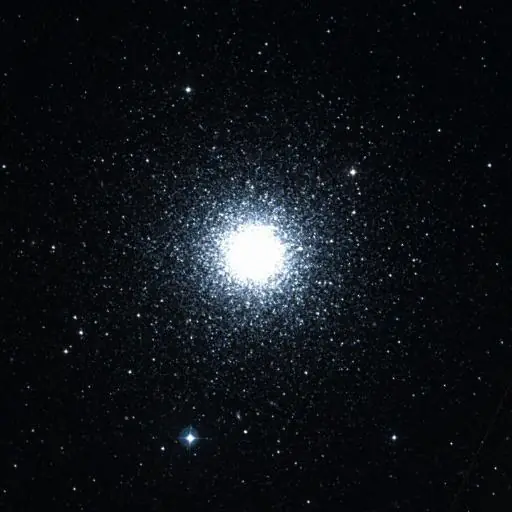
The first object Messier discovered himself — and the record holder for variable stars.
On 3 May 1764, Charles Messier spotted a small, round glow in Canes Venatici and logged it as a nebula without stars. It was the first entry in his catalogue that he discovered himself; M 1 and M 2 had been found by others. Around 1784, William Herschel’s larger telescopes showed what it really was: a globular cluster, a vast ball of stars.
Those stars are about 11.4 billion years old. M 3 floats on its own, high above the disc of the Milky Way, and has become one of the best-studied globular clusters of all. Many amateur astronomers rank it second only to M 13 among the globulars of the northern sky.
M 3 (NGC 5272) is 33,000 light-years away: the light we see from it set off about 33,000 years ago, when people were painting the oldest known cave art.
Did you know?
- Record holder. In 1913 Solon Bailey began cataloguing M 3’s variable stars. The count now stands at 274 — by far the most of any globular cluster — and new ones were still being found in 2025.
- Stars with a heartbeat. 133 of those variables are RR Lyrae stars, which pulse in a steady rhythm. About a third also show the Blazhko effect, a slower cycle that modulates their pulsing.
- A prototype. For a globular cluster, M 3 is relatively rich in heavier elements. It is the prototype of the Oosterhoff type I clusters, one of two families astronomers use to sort globulars by their pulsating stars.
How big is it?
About 410,000 Suns’ worth of stars in a ball 156 light-years wide. Light itself takes 156 years to cross it. That’s 37 times the distance from the Sun to the nearest star. In its core the stars are packed so tightly that each one’s nearest neighbour is about 52 light-days away. Our nearest neighbour, Proxima Centauri, is 4.2 light-years from the Sun — 30 times farther. To break free from its centre, a star would need 32 km/s — 2.9 times the speed a rocket needs to leave Earth. It will hold together for another 76 billion years or so — longer than the universe has existed. Shrink our Solar System — the Sun and all eight planets — to the size of a coin, and M 3 would be 3.92 km across (a 45-minute walk); the nearest star would be a football pitch away, and the Milky Way 2,520 km across.
One of the finest globular clusters, with about half a million stars and more known variable stars than any other. A 4-inch telescope starts to resolve its edges; larger ones show a sparkling ball with a bright core.
When and where to see it
It is best placed in the evening sky around May, when it crosses the meridian at about 10 pm local time (around midnight in April). It can be seen from everywhere north of 62°S and never sets north of 62°N.
At its highest it stands 68° up from 50°N, 83° up from 35°N, 62° up from the equator, 27° up from 35°S.
Facts
- Type
- Globular cluster
- Constellation
- Canes Venatici
- Designations
- NGC 5272
- Magnitude
- 6.2
- Apparent size
- 16′
- Position
- RA 13h 42.2m, Dec +28° 23′ (J2000)
- Distance
- 33,000 light-years
- Discovered
- Charles Messier, 1764
Open AstroPilot to see when M 3 (NGC 5272) is highest tonight from your location, how easy it is with your telescope or binoculars, and an eyepiece view.