M 28 (NGC 6626)
M 28 (NGC 6626) is a globular cluster in the constellation Sagittarius, magnitude 6.8, 11′ across.
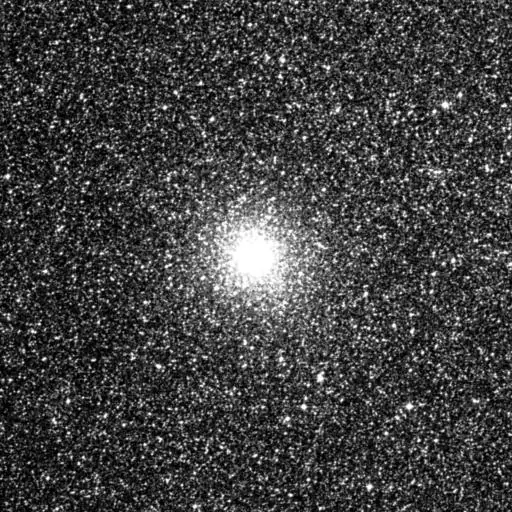
Where astronomers found the first millisecond pulsar inside a globular cluster.
Charles Messier noted M 28 in 1764 as a round “nebula containing no star”, seen with difficulty. It is in fact a globular cluster of ancient stars, roughly 12 billion years old, holding about 551,000 times the mass of the Sun. Its stars contain more than ten times less of the heavier elements than the Sun does — a mark of their great age.
Its place in history came from the Lovell Telescope at Jodrell Bank in England, which found the pulsar PSR B1821–24 here: the first millisecond pulsar ever discovered in a globular cluster. Eleven more have since been found in M 28 with the Green Bank Telescope in West Virginia. As of 2011, only Terzan 5 and 47 Tucanae had more.
M 28 (NGC 6626) is 18,000 light-years away: the light we see from it set off about 18,000 years ago, when the last Ice Age was at its height, and mammoths roamed beneath the ice sheets.
Did you know?
- Spun up by a partner. Millisecond pulsars are old neutron stars that have been spun up by pulling gas from a companion star, until they rotate hundreds of times a second.
- Stars with a daily rhythm. Eighteen RR Lyrae variable stars have been found in M 28 — old pulsating stars that brighten and fade in less than a day.
How big is it?
About 270,000 Suns’ worth of stars in a ball 59 light-years wide. Light itself takes 59 years to cross it. That’s 14 times the distance from the Sun to the nearest star. In its core the stars are packed so tightly that each one’s nearest neighbour is about 21 light-days away. Our nearest neighbour, Proxima Centauri, is 4.2 light-years from the Sun — 75 times farther. To break free from its centre, a star would need 41 km/s — 3.7 times the speed a rocket needs to leave Earth. The Milky Way’s tides will pull it apart in about 5.4 billion years. Shrink our Solar System — the Sun and all eight planets — to the size of a coin, and M 28 would be 1.48 km across (a 20-minute walk); the nearest star would be a football pitch away, and the Milky Way 2,520 km across.
A fairly compact globular cluster about 1° northwest of Lambda Sagittarii (Kaus Borealis), the star at the top of the Teapot's lid.
When and where to see it
It is best placed in the evening sky around July, when it crosses the meridian at about 10 pm local time (around midnight in June). It can be seen from everywhere south of 65°N and never sets south of 65°S.
At its highest it stands 15° up from 50°N, 30° up from 35°N, 65° up from the equator, 80° up from 35°S.
Facts
- Type
- Globular cluster
- Constellation
- Sagittarius
- Designations
- NGC 6626
- Magnitude
- 6.8
- Apparent size
- 11′
- Position
- RA 18h 24.5m, Dec −24° 52′ (J2000)
- Distance
- 18,000 light-years
- Discovered
- Charles Messier, 1764
Open AstroPilot to see when M 28 (NGC 6626) is highest tonight from your location, how easy it is with your telescope or binoculars, and an eyepiece view.