M 22 (NGC 6656)
M 22 (NGC 6656) is a globular cluster in the constellation Sagittarius, magnitude 5.1, 24′ across.
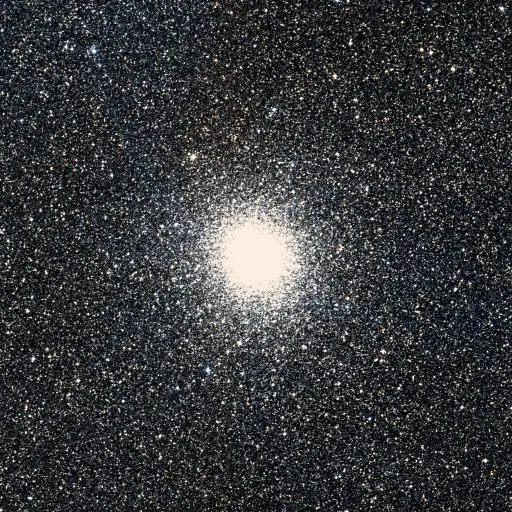
One of the first globular clusters ever found — hiding black holes and a young glowing shell.
In 1665 Abraham Ihle came across a fuzzy patch in Sagittarius: one of the first globular clusters ever discovered. Charles Messier added it to his catalogue in 1764. It was also one of the first to be studied carefully: in 1930 Harlow Shapley estimated it held roughly 70,000 stars around a dense core.
M 22 has surprising residents. In 2012 the Very Large Array radio telescope found two black holes, each of 10 to 20 solar masses, later backed up by the Chandra X-ray telescope. Astronomers had expected such black holes to be flung out of clusters. Now they estimate M 22 could hold anywhere from 5 to 100, and their pull on other stars may explain its unusually large core.
M 22 (NGC 6656) is 11,000 light-years away: the light we see from it set off around 8980 BC, 530 years after the stone pillars of Göbekli Tepe, the oldest known temple, were raised.
Did you know?
- A rare glowing shell. M 22 is one of only four globular clusters known to contain a planetary nebula. First noticed by the IRAS satellite in 1986, the shell, GJJC1, is probably only about 6,000 years old.
- A natural magnifying glass. M 22 sits in front of the crowded bulge of our galaxy. As its stars pass in front of more distant ones, their gravity can briefly brighten them — so it is a useful place to study microlensing.
- A mixed-up family. Its red giants show an unusually wide spread of colours, much like those of Omega Centauri. That puzzle has kept astronomers studying M 22 closely since 1977.
How big is it?
About 470,000 Suns’ worth of stars in a ball 77 light-years wide. Light itself takes 77 years to cross it. That’s 18 times the distance from the Sun to the nearest star. In its core the stars are packed so tightly that each one’s nearest neighbour is about 43 light-days away. Our nearest neighbour, Proxima Centauri, is 4.2 light-years from the Sun — 36 times farther. To break free from its centre, a star would need 36 km/s — 3.2 times the speed a rocket needs to leave Earth. It will hold together for another 47 billion years or so — longer than the universe has existed. Shrink our Solar System — the Sun and all eight planets — to the size of a coin, and M 22 would be 1.94 km across (a 25-minute walk); the nearest star would be a football pitch away, and the Milky Way 2,520 km across.
One of the brightest globular clusters, visible to the naked eye from dark sites and among the nearest at about 10,000 light-years. Even small telescopes resolve its brightest stars; it sits low for northern observers but is well worth catching.
When and where to see it
It is best placed in the evening sky around July, when it crosses the meridian at about 10 pm local time (around midnight in June). It can be seen from everywhere south of 66°N and never sets south of 66°S.
At its highest it stands 16° up from 50°N, 31° up from 35°N, 66° up from the equator, 79° up from 35°S.
Facts
- Type
- Globular cluster
- Constellation
- Sagittarius
- Designations
- NGC 6656, Great Sagittarius Cluster
- Magnitude
- 5.1
- Apparent size
- 24′
- Position
- RA 18h 36.4m, Dec −23° 54′ (J2000)
- Distance
- 11,000 light-years
- Discovered
- Abraham Ihle, 1665
Open AstroPilot to see when M 22 (NGC 6656) is highest tonight from your location, how easy it is with your telescope or binoculars, and an eyepiece view.