M 2 (NGC 7089)
M 2 (NGC 7089) is a globular cluster in the constellation Aquarius, magnitude 6.5, 13′ across.
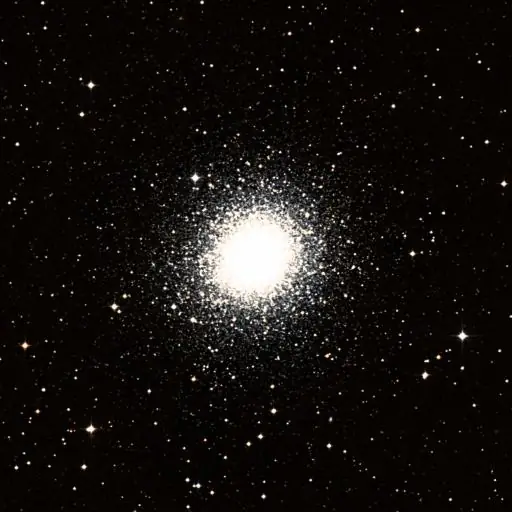
150,000 ancient suns — and perhaps a souvenir of a dwarf galaxy the Milky Way swallowed long ago.
Imagine some 150,000 stars, around 12.5 billion years old, crowded into a single ball. M 2 is one of the larger globular clusters known, and it does not sit in the Milky Way’s disc at all. It drifts through the galactic halo, below the galaxy’s southern pole. Its brightest stars are red and yellow giants — suns nearing the end of their lives.
M 2 may not have been born here. It is counted as part of the Gaia Sausage, the suspected remains of a dwarf galaxy that merged with ours long ago. Data from the Gaia spacecraft have also revealed a long stream of stars, stretching about 45 degrees across the sky, that is probably being pulled away from the cluster.
M 2 (NGC 7089) is 38,000 light-years away: the light we see from it set off about 38,000 years ago, when people were painting the oldest known cave art.
Did you know?
- Found while chasing a comet. Jean-Dominique Maraldi spotted M 2 in 1746 while observing a comet with Jacques Cassini. Messier saw it in 1760 and took it for a starless nebula; William Herschel first resolved its stars in 1783.
- Older than it looks?. Most estimates put M 2 at about 12.5 billion years old, but one recent study argues for at least 13.2 billion — close to the age of the universe itself.
How big is it?
About 620,000 Suns’ worth of stars in a ball 143 light-years wide. Light itself takes 143 years to cross it. That’s 34 times the distance from the Sun to the nearest star. In its core the stars are packed so tightly that each one’s nearest neighbour is about 31 light-days away. Our nearest neighbour, Proxima Centauri, is 4.2 light-years from the Sun — 50 times farther. To break free from its centre, a star would need 44 km/s — 3.9 times the speed a rocket needs to leave Earth. It will hold together for another 20 billion years or so — longer than the universe has existed. Shrink our Solar System — the Sun and all eight planets — to the size of a coin, and M 2 would be 3.6 km across (a 45-minute walk); the nearest star would be a football pitch away, and the Milky Way 2,520 km across.
A rich, compact globular cluster in Aquarius. Binoculars show a fuzzy star; an 8-inch telescope resolves its outer halo into a swarm of faint stars around a bright, dense core.
When and where to see it
It is best placed in the evening sky around September, when it crosses the meridian at about 10 pm local time (around midnight in August). It sits on the celestial equator, so it can be seen from almost everywhere on Earth.
At its highest it stands 39° up from 50°N, 54° up from 35°N, 89° up from the equator, 56° up from 35°S.
Facts
- Type
- Globular cluster
- Constellation
- Aquarius
- Designations
- NGC 7089
- Magnitude
- 6.5
- Apparent size
- 13′
- Position
- RA 21h 33.5m, Dec −0° 49′ (J2000)
- Distance
- 38,000 light-years
- Discovered
- Jean-Dominique Maraldi, 1746
Open AstroPilot to see when M 2 (NGC 7089) is highest tonight from your location, how easy it is with your telescope or binoculars, and an eyepiece view.