M 19 (NGC 6273)
M 19 (NGC 6273) is a globular cluster in the constellation Ophiuchus, magnitude 6.8, 14′ across.
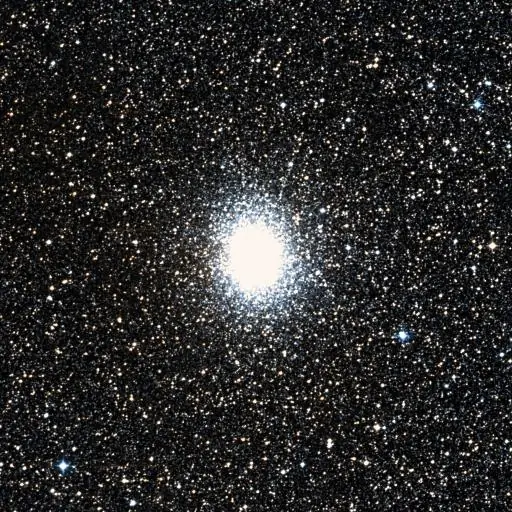
It looks like one of the most squashed globular clusters — but the squashing may be a trick of dust.
M 19 appears to be one of the most flattened globular clusters known. But looks deceive. Gas and dust between us and the cluster strongly absorb its light along the eastern edge, dimming and reddening it. In infrared light, which slips through dust more easily, the cluster looks almost perfectly round.
It lies close to the centre of the Milky Way and is a heavyweight: about 1.1 million times the mass of the Sun, in stars around 11.9 billion years old.
Charles Messier found it on 5 June 1764. William Herschel resolved it into stars in 1784, and his son John later called it “a superb cluster resolvable into countless stars”.
M 19 (NGC 6273) is 27,000 light-years away: the light we see from it set off about 27,000 years ago, when the last Ice Age was at its height, and mammoths roamed beneath the ice sheets.
Did you know?
- Pulsing giants. M 19’s stars include Cepheids and RV Tauri variables — pulsating giants that swell and shrink — plus at least one RR Lyrae star with a known period.
- Quiet in X-rays. The ROSAT X-ray satellite searched M 19 for faint X-ray sources and found none.
How big is it?
About 720,000 Suns’ worth of stars in a ball 106 light-years wide. Light itself takes 106 years to cross it. That’s 25 times the distance from the Sun to the nearest star. In its core the stars are packed so tightly that each one’s nearest neighbour is about 40 light-days away. Our nearest neighbour, Proxima Centauri, is 4.2 light-years from the Sun — 39 times farther. To break free from its centre, a star would need 45 km/s — 4 times the speed a rocket needs to leave Earth. It will hold together for another 24 billion years or so — longer than the universe has existed. Shrink our Solar System — the Sun and all eight planets — to the size of a coin, and M 19 would be 2.68 km across (a 30-minute walk); the nearest star would be a football pitch away, and the Milky Way 2,520 km across.
One of the most oblate globular clusters known, visibly oval in a telescope. It lies close to the center of the Milky Way, behind a veil of dust.
When and where to see it
It is best placed in the evening sky around July, when it crosses the meridian at about 10 pm local time (around midnight in June). It can be seen from everywhere south of 64°N and never sets south of 64°S.
At its highest it stands 14° up from 50°N, 29° up from 35°N, 64° up from the equator, 81° up from 35°S.
Facts
- Type
- Globular cluster
- Constellation
- Ophiuchus
- Designations
- NGC 6273
- Magnitude
- 6.8
- Apparent size
- 14′
- Position
- RA 17h 2.6m, Dec −26° 16′ (J2000)
- Distance
- 27,000 light-years
- Discovered
- Charles Messier, 1764
Open AstroPilot to see when M 19 (NGC 6273) is highest tonight from your location, how easy it is with your telescope or binoculars, and an eyepiece view.