M 15 (NGC 7078)
M 15 (NGC 7078) is a globular cluster in the constellation Pegasus, magnitude 6.2, 12′ across.
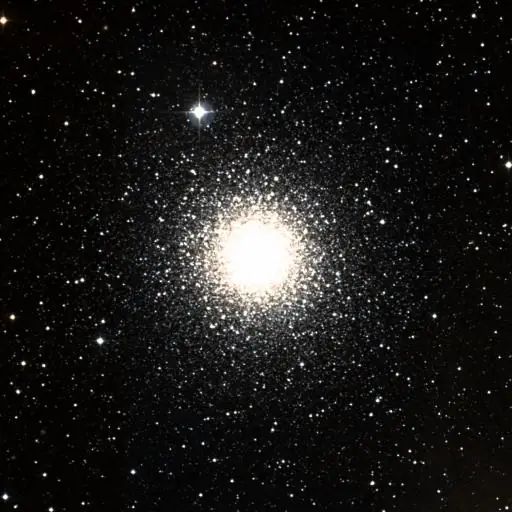
About 12.5 billion years old, crowded to the point of collapse, and home to eight pulsars.
M 15 is a survivor from the dawn of the Milky Way. At around 12.5 billion years old, it is one of the oldest globular clusters known, and more than 100,000 stars crowd into it. Over time its core has shrunk in on itself — a “core collapse” — piling up a huge number of stars around what may be a central black hole.
Jean-Dominique Maraldi discovered it in 1746, and Messier added it to his catalogue in 1764. In 1928 astronomers found a surprise inside: Pease 1, a planetary nebula — the shed outer layers of a dying star. Only three others have been found in globular clusters since.
M 15 (NGC 7078) is 35,000 light-years away: the light we see from it set off about 35,000 years ago, when people were painting the oldest known cave art.
Did you know?
- A nest of pulsars. M 15 holds eight known pulsars, including M15-C, a pair of neutron stars orbiting each other — the crushed cores of two exploded stars.
- X-ray beacons. Satellites including Uhuru and Chandra have found two bright X-ray sources in M 15. The first, M 15 X-1, was the first X-ray source detected in Pegasus.
- A pulsing crowd. Along with its pulsars, M 15 is home to 112 known variable stars.
How big is it?
About 520,000 Suns’ worth of stars in a ball 125 light-years wide. Light itself takes 125 years to cross it. That’s 30 times the distance from the Sun to the nearest star. In its core the stars are packed so tightly that each one’s nearest neighbour is about 6 light-days away. Our nearest neighbour, Proxima Centauri, is 4.2 light-years from the Sun — 270 times farther. To break free from its centre, a star would need 49 km/s — 4.4 times the speed a rocket needs to leave Earth. It will hold together for another 65 billion years or so — longer than the universe has existed. Shrink our Solar System — the Sun and all eight planets — to the size of a coin, and M 15 would be 3.16 km across (a 40-minute walk); the nearest star would be a football pitch away, and the Milky Way 2,520 km across.
A bright, very dense globular cluster whose core has collapsed, giving it a tiny, intense center at any magnification. It also holds Pease 1, the first planetary nebula found inside a globular cluster.
When and where to see it
It is best placed in the evening sky around September, when it crosses the meridian at about 10 pm local time (around midnight in August). It can be seen from everywhere north of 78°S and never sets north of 78°N.
At its highest it stands 52° up from 50°N, 67° up from 35°N, 78° up from the equator, 43° up from 35°S.
Facts
- Type
- Globular cluster
- Constellation
- Pegasus
- Designations
- NGC 7078, Great Pegasus Cluster
- Magnitude
- 6.2
- Apparent size
- 12′
- Position
- RA 21h 30.0m, Dec +12° 10′ (J2000)
- Distance
- 35,000 light-years
- Discovered
- Jean-Dominique Maraldi, 1746
Open AstroPilot to see when M 15 (NGC 7078) is highest tonight from your location, how easy it is with your telescope or binoculars, and an eyepiece view.