M 14 (NGC 6402)
M 14 (NGC 6402) is a globular cluster in the constellation Ophiuchus, magnitude 7.6, 12′ across.
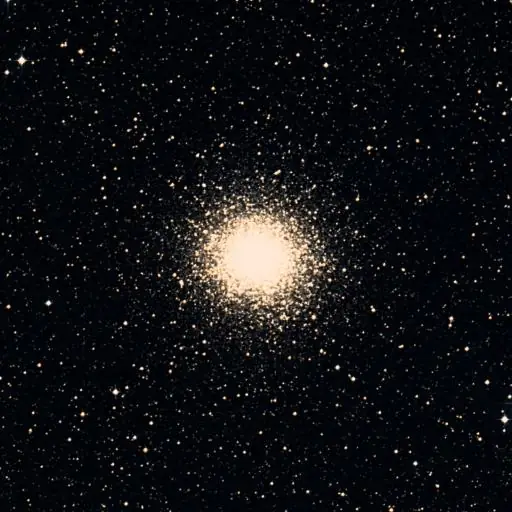
A nova flared here in 1938 — and nobody noticed for 26 years.
Several hundred thousand stars crowd into M 14, together shining about 400,000 times brighter than the Sun. Charles Messier discovered this globular cluster in 1764. Unlike most of its kind, it is not round but decidedly elongated.
In 1938 something happened in M 14 that no one saw. A star suddenly flared up as a nova, briefly outshining every ordinary star in the cluster. The outburst sat unnoticed on photographic plates until 1964, when astronomers studying them finally spotted it — a discovery made 26 years late.
M 14 (NGC 6402) is 30,000 light-years away: the light we see from it set off about 30,000 years ago, when people were painting the oldest known cave art.
Did you know?
- A crowd of pulsing stars. About 70 variable stars are known in M 14. Many are W Virginis stars, old pulsating giants that brighten and fade over a matter of days or weeks.
- What is a nova?. A nova happens when a white dwarf steals gas from a close companion until the stolen layer ignites in a runaway blast. The star survives, and can flare again.
How big is it?
About 600,000 Suns’ worth of stars in a ball 102 light-years wide. Light itself takes 102 years to cross it. That’s 24 times the distance from the Sun to the nearest star. In its core the stars are packed so tightly that each one’s nearest neighbour is about 2 light-months away. Our nearest neighbour, Proxima Centauri, is 4.2 light-years from the Sun — 21 times farther. To break free from its centre, a star would need 36 km/s — 3.2 times the speed a rocket needs to leave Earth. The Milky Way’s tides will pull it apart in about 11 billion years. Shrink our Solar System — the Sun and all eight planets — to the size of a coin, and M 14 would be 2.58 km across (a 30-minute walk); the nearest star would be a football pitch away, and the Milky Way 2,520 km across.
A large but rather faint globular cluster in a sparse part of Ophiuchus. It looks evenly grainy; its stars are faint, so it needs about 8 inches of aperture to resolve.
When and where to see it
It is best placed in the evening sky around July, when it crosses the meridian at about 10 pm local time (around midnight in June). It can be seen from everywhere south of 87°N and never sets south of 87°S.
At its highest it stands 37° up from 50°N, 52° up from 35°N, 87° up from the equator, 58° up from 35°S.
Facts
- Type
- Globular cluster
- Constellation
- Ophiuchus
- Designations
- NGC 6402
- Magnitude
- 7.6
- Apparent size
- 12′
- Position
- RA 17h 37.6m, Dec −3° 15′ (J2000)
- Distance
- 30,000 light-years
- Discovered
- Charles Messier, 1764
Open AstroPilot to see when M 14 (NGC 6402) is highest tonight from your location, how easy it is with your telescope or binoculars, and an eyepiece view.