Hercules Globular Cluster (M 13)
Hercules Globular Cluster (M 13) is a globular cluster in the constellation Hercules, magnitude 5.8, 17′ across.
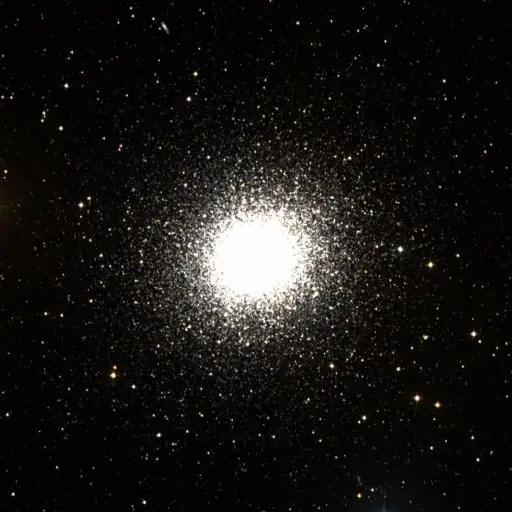
The great star ball of Hercules — and the target of humanity’s first message to the stars.
Picture several hundred thousand suns packed into one ball of light. Its stars are packed more than a hundred times more densely than those around the Sun — so close that some collide and merge, forming young-looking “blue stragglers”. It is a globular cluster of ancient stars, with only about 4.6% as much iron as the Sun, born when the galaxy was young.
Edmond Halley — of comet fame — came across it in 1714. Charles Messier added it to his list on 1 June 1764, and its individual stars were first resolved in 1779. It is one of more than a hundred globular clusters that orbit the centre of the Milky Way.
Science fiction loves it. Isaac Asimov and Poul Anderson set stories on a world inside it, the Arkonides of Perry Rhodan call it home, and in Doctor Who the Cybermen plotted to make one of its stars go nova.
Hercules Globular Cluster (M 13) is 24,000 light-years away: the light we see from it set off about 24,000 years ago, when the last Ice Age was at its height, and mammoths roamed beneath the ice sheets.
Did you know?
- A postcard to the stars. In 1974 the Arecibo radio telescope beamed a message towards M 13 describing humans, DNA and Earth’s place in the Solar System. It is still on its way, and will be for many thousands of years.
- Painted on a church dome. M 13 appears inside the dome of St Anne’s Church, Kew, in London, based on a NASA photograph. Halley found the cluster in 1714 — the year the church was first dedicated.
- Still finding new stars. Its variable stars are still being catalogued: the three most recent, V63, V64 and V65, were found by observers in Spain between 2021 and 2024.
How big is it?
About 480,000 Suns’ worth of stars in a ball 116 light-years wide. Light itself takes 116 years to cross it. That’s 27 times the distance from the Sun to the nearest star. In its core the stars are packed so tightly that each one’s nearest neighbour is about 2 light-months away. Our nearest neighbour, Proxima Centauri, is 4.2 light-years from the Sun — 21 times farther. To break free from its centre, a star would need 32 km/s — 2.9 times the speed a rocket needs to leave Earth. It will hold together for another 26 billion years or so — longer than the universe has existed. Shrink our Solar System — the Sun and all eight planets — to the size of a coin, and the Hercules Globular Cluster would be 2.92 km across (a 35-minute walk); the nearest star would be a football pitch away, and the Milky Way 2,520 km across.
The Great Globular Cluster in Hercules, the finest in the northern sky: binoculars show a bright fuzzy ball, and a 6-inch telescope resolves hundreds of stars. It lies on the western side of the Keystone asterism.
When and where to see it
It is best placed in the evening sky around July, when it crosses the meridian at about 10 pm local time (around midnight in June). It can be seen from everywhere north of 54°S and never sets north of 54°N.
At its highest it stands 76° up from 50°N, 89° up from 35°N, 54° up from the equator, 19° up from 35°S.
Facts
- Type
- Globular cluster
- Constellation
- Hercules
- Designations
- M 13, NGC 6205, Great Hercules Cluster
- Magnitude
- 5.8
- Apparent size
- 17′
- Position
- RA 16h 41.7m, Dec +36° 28′ (J2000)
- Distance
- 24,000 light-years
- Discovered
- Edmond Halley, 1714
Open AstroPilot to see when Hercules Globular Cluster (M 13) is highest tonight from your location, how easy it is with your telescope or binoculars, and an eyepiece view.