M 10 (NGC 6254)
M 10 (NGC 6254) is a globular cluster in the constellation Ophiuchus, magnitude 6.6, 15′ across.
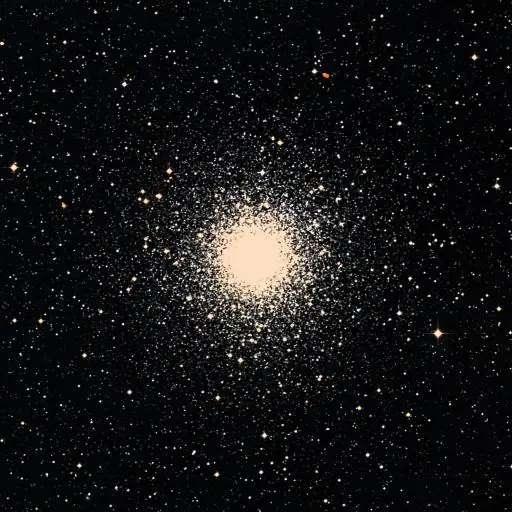
An ancient star swarm where gravity sorts the stars and old ones are reborn as blue stragglers.
On 29 May 1764, Charles Messier described M 10 as a “nebula without stars”. Ten years later Johann Bode agreed, calling it “very pale”. It took William Herschel’s larger telescope to reveal “a beautiful cluster of extremely compressed stars” — a globular cluster. Lord Rosse later thought he could see a dark lane crossing part of it.
Inside, gravity sorts the stars. Pairs of stars weigh more than single ones, so they sink towards the centre: about 14% of the stars in the core are binaries, against 1.5% in the outskirts. Crowded together, some of these pairs merge or trade mass, becoming blue stragglers — stars that look younger than their neighbours. Most of M 10’s blue stragglers formed 2–5 billion years ago.
M 10 (NGC 6254) is 17,000 light-years away: the light we see from it set off about 17,000 years ago, when the last Ice Age was at its height, and mammoths roamed beneath the ice sheets.
Did you know?
- A looping orbit. M 10 circles the Milky Way about every 140 million years on a rosette-shaped path, crossing the galaxy’s disc every 53 million years or so.
- Pulsars and pulsators. Among its 35 known variable stars are 16 SX Phoenicis stars, pulsating blue stragglers. The cluster also hosts two millisecond pulsars, each spinning hundreds of times a second.
- A first guess, too far. Harlow Shapley was the first to estimate how far away M 10 lies. His figure turned out to be more than twice the modern value.
How big is it?
About 190,000 Suns’ worth of stars in a ball 75 light-years wide. Light itself takes 75 years to cross it. That’s 18 times the distance from the Sun to the nearest star. In its core the stars are packed so tightly that each one’s nearest neighbour is about 52 light-days away. Our nearest neighbour, Proxima Centauri, is 4.2 light-years from the Sun — 30 times farther. To break free from its centre, a star would need 24 km/s — 2.1 times the speed a rocket needs to leave Earth. The Milky Way’s tides will pull it apart in about 13 billion years. Shrink our Solar System — the Sun and all eight planets — to the size of a coin, and M 10 would be 1.88 km across (a 25-minute walk); the nearest star would be a football pitch away, and the Milky Way 2,520 km across.
A bright globular cluster in Ophiuchus, about 17,000 light-years away. Binoculars show it in the same sweep as its near-twin M12, 3° away, and a 6-inch telescope resolves its outskirts.
When and where to see it
It is best placed in the evening sky around July, when it crosses the meridian at about 10 pm local time (around midnight in June). It can be seen from everywhere south of 86°N and never sets south of 86°S.
At its highest it stands 36° up from 50°N, 51° up from 35°N, 86° up from the equator, 59° up from 35°S.
Facts
- Type
- Globular cluster
- Constellation
- Ophiuchus
- Designations
- NGC 6254
- Magnitude
- 6.6
- Apparent size
- 15′
- Position
- RA 16h 57.2m, Dec −4° 6′ (J2000)
- Distance
- 17,000 light-years
- Discovered
- Charles Messier, 1764
Open AstroPilot to see when M 10 (NGC 6254) is highest tonight from your location, how easy it is with your telescope or binoculars, and an eyepiece view.