IC 444
IC 444 is a reflection nebula in the constellation Gemini, magnitude 7.0 (blue), 8.0′ × 4.0′ across.
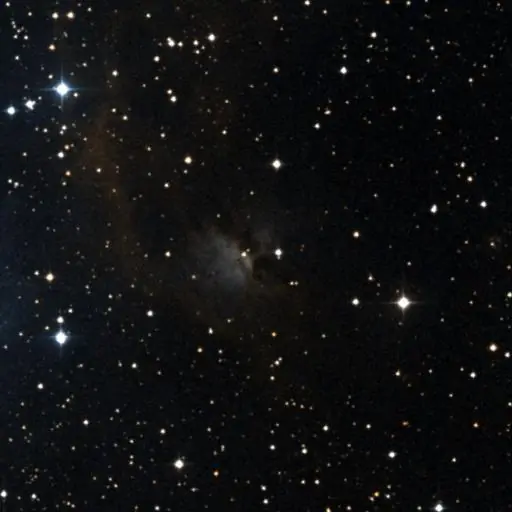
A nebula nobody can quite pin down: astronomers still argue over which cloud in Gemini it really is.
Some objects are lost not because they faded, but because their positions were muddled. J. L. E. Dreyer added IC 444 to his Index Catalogue from photographic discoveries by Max Wolf and E. E. Barnard, noting a nebula with a star involved. Yet his position falls on empty sky.
Most people now identify it with LBN 840, a small reflection nebula beside the stars 10, 11 and 12 Geminorum. One researcher calls this a bad match, arguing that it is too small and faint for Wolf’s little lens to have recorded.
Did you know?
- Other suspects. Wolfgang Steinicke matched IC 444 to the nebulosity around Mu Geminorum; Harold Corwin placed it among the clouds north-east of the Jellyfish Nebula. Others call it simply lost.
A 7.0-magnitude (B-band) reflection nebula in Gemini, about 8′ × 4′.
When and where to see it
It is best placed in the evening sky around January, when it crosses the meridian at about 10 pm local time (around midnight in December). It can be seen from everywhere north of 67°S and never sets north of 67°N.
At its highest it stands 63° up from 50°N, 78° up from 35°N, 67° up from the equator, 32° up from 35°S.
Facts
- Type
- Reflection nebula
- Constellation
- Gemini
- Designations
- IC 444
- Magnitude
- 7.0 (blue)
- Apparent size
- 8.0′ × 4.0′
- Position
- RA 6h 18.6m, Dec +23° 19′ (J2000)
- Discovered
- Max Wolf and E. E. Barnard, Found on photographs between 1888 and 1894; which nebula they recorded is uncertain
Open AstroPilot to see when IC 444 is highest tonight from your location, how easy it is with your telescope or binoculars, and an eyepiece view.