Hidden Galaxy (IC 342)
Hidden Galaxy (IC 342) is a galaxy in the constellation Camelopardalis, magnitude 9.7 (blue), 20′ × 19′ across.
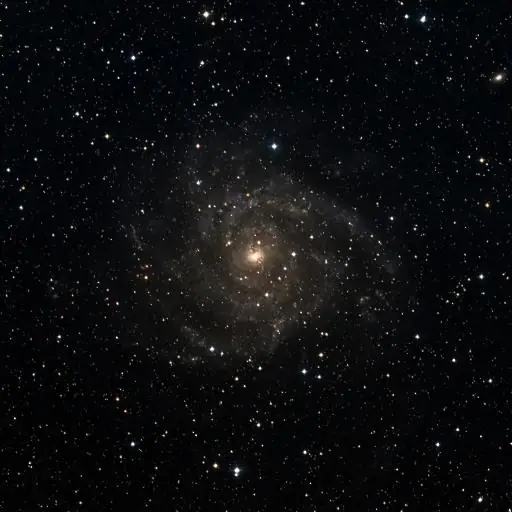
A great spiral peeking through the Milky Way’s dust — once thought to be one of our own Local Group.
Few galaxies have been so hard to size up. In 1935 Harlow Shapley measured IC 342 and found it wider than the full Moon — by apparent size the third-largest spiral galaxy then known, beaten only by Andromeda and Triangulum. Modern estimates are more modest, at half to two-thirds of the Moon’s width, but it is still a giant of our sky.
Edwin Hubble first thought it belonged to our own Local Group. It doesn’t: it is one of the brightest members of the IC 342/Maffei Group, one of the closest galaxy groups to ours. The dust of the Milky Way’s disc dims it so badly that even its distance is hard to pin down.
It is a quiet neighbour, too. Unlike Andromeda, with its swarm of small companions, IC 342 has few dwarf satellite galaxies; the first dwarf spheroidal around it, KKH 32, was only identified in 2020.
Hidden Galaxy (IC 342) is 11 million light-years away: the light we see from it set off about 11 million years ago, when great apes were spreading through Africa and Europe.
Did you know?
- A meteor man’s galaxy. William Frederick Denning, who found it in 1892, was a British amateur from Bristol best known for his studies of meteors — and the discoverer of several comets.
- A star-forming heart. Its nucleus is classed as an H II nucleus: a core lit up by young, hot stars and the gas around them, rather than by a feeding black hole.
How big is it?
63% of the Milky Way’s width. Light itself takes 63,000 years to cross it. Shrink it to the length of a football pitch and our whole Solar System would be smaller than a bacterium. It holds about 100 billion stars — the Milky Way has a few hundred billion.
A large face-on spiral hidden behind the dust of the Milky Way — without that veil it would be one of the brightest galaxies in the sky. It needs dark skies and low power.
When and where to see it
It is best placed in the evening sky around December, when it crosses the meridian at about 10 pm local time (around midnight in November). It can be seen from everywhere north of 22°S and never sets north of 22°N.
At its highest it stands 72° up from 50°N, 57° up from 35°N, 22° up from the equator, below the horizon from 35°S.
Facts
- Type
- Galaxy
- Constellation
- Camelopardalis
- Designations
- IC 342, C 5
- Magnitude
- 9.7 (blue)
- Apparent size
- 20′ × 19′
- Position
- RA 3h 46.8m, Dec +68° 6′ (J2000)
- Distance
- 11 million light-years
- Discovered
- William Frederick Denning, 1892
Open AstroPilot to see when Hidden Galaxy (IC 342) is highest tonight from your location, how easy it is with your telescope or binoculars, and an eyepiece view.