Coddington's Nebula (IC 2574)
Coddington's Nebula (IC 2574) is a galaxy in the constellation Ursa Major, magnitude 10.5, 13′ × 5.6′ across.
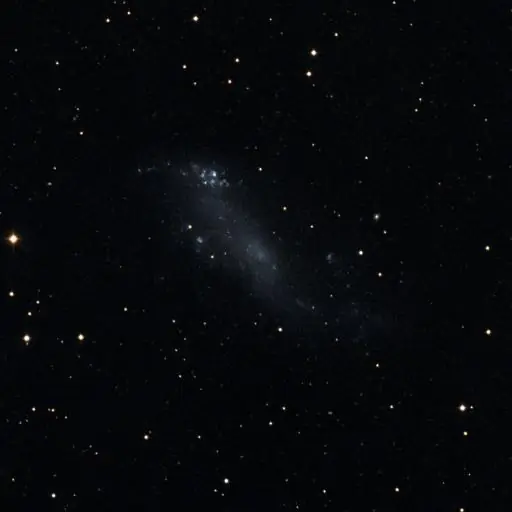
Coddington’s Nebula: a dwarf galaxy in the M 81 group that is about nine-tenths dark matter.
Edwin Coddington found this faint glow in Ursa Major in 1898, and it still carries his name: Coddington’s Nebula. It is really a dwarf galaxy, an outlying member of the M 81 group. Most of it cannot be seen. About 90% of its mass is thought to be dark matter, with its stars and gas only a thin sprinkling. It shows no sign of being disturbed by other galaxies, yet it is still forming stars, in clumps scattered through it.
Coddington's Nebula (IC 2574) is 13 million light-years away: the light we see from it set off about 13 million years ago, when great apes were spreading through Africa and Europe.
How big is it?
49% of the Milky Way’s width. Light itself takes 49,000 years to cross it. Shrink it to the length of a football pitch and our whole Solar System would be smaller than a bacterium.
A 10.5-magnitude weakly barred Magellanic spiral galaxy (SABm) in Ursa Major, about 13′ × 5.6′.
When and where to see it
It is best placed in the evening sky around March, when it crosses the meridian at about 10 pm local time (around midnight in February). It can be seen from everywhere north of 22°S and never sets north of 22°N.
At its highest it stands 72° up from 50°N, 57° up from 35°N, 22° up from the equator, below the horizon from 35°S.
Facts
- Type
- Galaxy
- Constellation
- Ursa Major
- Designations
- IC 2574
- Magnitude
- 10.5
- Apparent size
- 13′ × 5.6′
- Position
- RA 10h 28.4m, Dec +68° 25′ (J2000)
- Distance
- 13 million light-years
- Discovered
- Edwin Foster Coddington, 1898
Open AstroPilot to see when Coddington's Nebula (IC 2574) is highest tonight from your location, how easy it is with your telescope or binoculars, and an eyepiece view.