IC 10
IC 10 is a galaxy in the constellation Cassiopeia, magnitude 10.3, 6.8′ × 6.0′ across.
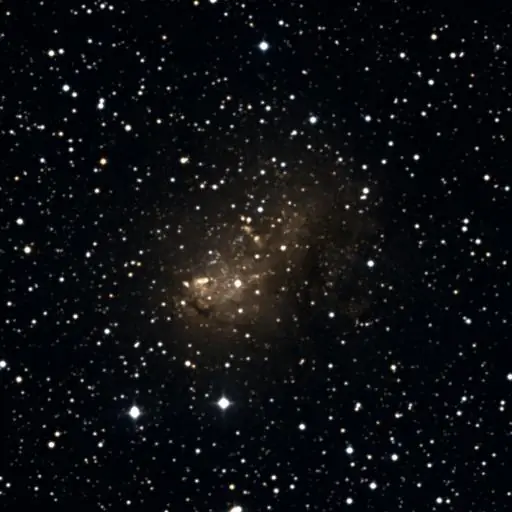
The Local Group’s only starburst galaxy, hiding behind the dust of our own Milky Way.
Our cosmic neighbourhood holds dozens of galaxies, but only one is in the middle of a starburst: IC 10. It is crowded with Wolf–Rayet stars — rare, very hot, massive stars near the ends of their lives — packed more densely than in either Magellanic Cloud. Studying it is hard, though, because it lies close to the plane of the Milky Way and we must peer at it through thick dust.
Lewis Swift discovered it on 8 October 1887. Nicholas Mayall suggested in 1935 that it lay beyond our galaxy, but its place in the Local Group was only confirmed in 1996.
IC 10 is 2.3 million light-years away: the light we see from it set off about 2.3 million years ago, when our distant ancestors were making the first stone tools.
Did you know?
- Turning the other way. IC 10 sits inside a huge envelope of hydrogen gas, far larger than the galaxy we see — and the visible galaxy seems to rotate in a different direction from it.
How big is it?
A dwarf beside the Milky Way. Light itself takes 4,520 years to cross it. Shrink it to the length of a football pitch and our whole Solar System would be thinner than a human hair.
A 10.3-magnitude barred irregular galaxy (IB) in Cassiopeia, about 6.8′ × 6′.
When and where to see it
It is best placed in the evening sky around October, when it crosses the meridian at about 10 pm local time (around midnight in September). It can be seen from everywhere north of 31°S and never sets north of 31°N.
At its highest it stands 81° up from 50°N, 66° up from 35°N, 31° up from the equator, below the horizon from 35°S.
Facts
- Type
- Galaxy
- Constellation
- Cassiopeia
- Designations
- IC 10
- Magnitude
- 10.3
- Apparent size
- 6.8′ × 6.0′
- Position
- RA 0h 20.3m, Dec +59° 18′ (J2000)
- Distance
- 2.3 million light-years
- Discovered
- Lewis Swift, 1887
Open AstroPilot to see when IC 10 is highest tonight from your location, how easy it is with your telescope or binoculars, and an eyepiece view.