Stephan's Quintet (HCG 92)
Stephan's Quintet (HCG 92) is a galaxy group in the constellation Pegasus, 3.2′ across.
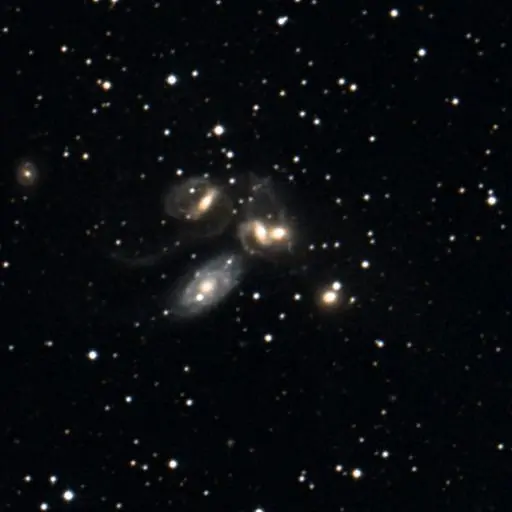
The first compact group of galaxies ever found — and one of the first sights the Webb telescope showed us.
In 1877, at Marseille Observatory, Édouard Stephan found a tight knot of five galaxies in Pegasus — the first compact galaxy group & cluster ever discovered. Only four are true companions, though. The brightest, NGC 7320, is a foreground galaxy, much closer to us, that simply lies in the same direction.
The other four are locked in a slow-motion collision. One of them, NGC 7318B, is falling into the group at several million kilometres an hour, driving a shock wave through the gas between the galaxies.
Stephan's Quintet (HCG 92) is 290 million light-years away: the light we see from it set off about 290 million years ago, when the first plants and animals were moving onto land.
Did you know?
- Webb’s first look. In July 2022 Stephan’s Quintet was one of five targets in the first science images released from the James Webb Space Telescope.
- A film star. In the 1946 film It’s a Wonderful Life, the angels discussing George Bailey’s fate are shown as the galaxies of Stephan’s Quintet.
- A shock bigger than a galaxy. The shock wave is bigger than the whole Milky Way, and heats the gas between the galaxies to millions of degrees, making it shine in X-rays.
How big is it?
2.7 times as wide as our Milky Way. Light itself takes 270,000 years to cross it. Shrink it to the length of a football pitch and our whole Solar System would be smaller than a bacterium.
A group of galaxies in Pegasus, about 3.2′ across.
When and where to see it
It is best placed in the evening sky around October, when it crosses the meridian at about 10 pm local time (around midnight in August). It can be seen from everywhere north of 56°S and never sets north of 56°N.
At its highest it stands 74° up from 50°N, 89° up from 35°N, 56° up from the equator, 21° up from 35°S.
Facts
- Type
- Galaxy group
- Constellation
- Pegasus
- Designations
- HCG 92
- Apparent size
- 3.2′
- Position
- RA 22h 36.0m, Dec +33° 57′ (J2000)
- Distance
- 290 million light-years
- Discovered
- Édouard Stephan, 1877
Open AstroPilot to see when Stephan's Quintet (HCG 92) is highest tonight from your location, how easy it is with your telescope or binoculars, and an eyepiece view.