Seyfert's Sextet (HCG 79)
Seyfert's Sextet (HCG 79) is a galaxy group in the constellation Serpens, 1.3′ across.
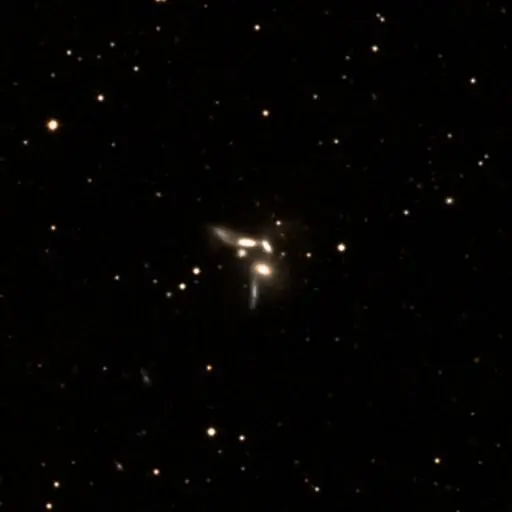
Six members, only four real galaxies: a tiny group where one ‘galaxy’ is a tail and another lies far behind.
Carl Seyfert counted six members in this tiny galaxy group & cluster in 1948, and in 1951 described it as the most compact group of galaxies then known. The name stuck; the count did not. Only four of the six are galaxies tangled together by gravity. One ‘member’ is a tidal tail of stars and gas flung out of the central galaxy, NGC 6027, and another is a spiral far in the background, more than four times as distant, lined up purely by chance.
Seyfert's Sextet (HCG 79) is 200 million light-years away: the light we see from it set off about 200 million years ago, when dinosaurs were rising and the supercontinent Pangaea was breaking apart.
Did you know?
- One galaxy, eventually. Simulations suggest the four true members will keep spiralling inwards and eventually merge into a single giant elliptical galaxy.
- Stephan saw it first. Édouard Stephan spotted the group on 17 June 1876 at Marseille, but logged it as a single nebula, NGC 6027.
How big is it?
76% of the Milky Way’s width. Light itself takes 76,000 years to cross it. Shrink it to the length of a football pitch and our whole Solar System would be smaller than a bacterium.
A group of galaxies in Serpens, about 1.3′ across.
When and where to see it
It is best placed in the evening sky around June, when it crosses the meridian at about 10 pm local time (around midnight in May). It can be seen from everywhere north of 69°S and never sets north of 69°N.
At its highest it stands 61° up from 50°N, 76° up from 35°N, 69° up from the equator, 34° up from 35°S.
Facts
- Type
- Galaxy group
- Constellation
- Serpens
- Designations
- HCG 79
- Apparent size
- 1.3′
- Position
- RA 15h 59.2m, Dec +20° 46′ (J2000)
- Distance
- 200 million light-years
- Discovered
- Carl Seyfert, 1948, Édouard Stephan had logged it in 1876 as a single nebula, NGC 6027
Open AstroPilot to see when Seyfert's Sextet (HCG 79) is highest tonight from your location, how easy it is with your telescope or binoculars, and an eyepiece view.