Zeta Lyrae (ζ Lyr)
Zeta Lyrae (ζ Lyr) is a double star in the constellation Lyra, magnitude 4.3.
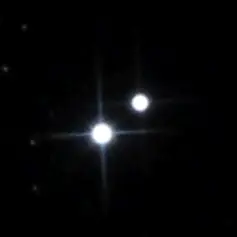
A triple star in the Lyre whose two visible members received their names only in 2026.
Three stars hide in this wide pair. The brighter, Zeta¹ Lyrae, is itself a close spectroscopic binary: two stars too near each other to see apart, revealed only by the regular shifting of the lines in their spectrum. Its main star is an “Am” star, whose light shows unusually strong lines of certain metals.
Its companion, Zeta² Lyrae, is an F-type subgiant — a star that is moving on from the long, steady hydrogen-burning stage our Sun is in now. The two are believed to be physically bound, travelling through space as one system.
In 2026 the IAU gave both stars names taken from cultural star patterns in Lyra: Kautoki for the brighter star’s primary, and Urquchillay for its companion.
Zeta Lyrae (ζ Lyr) is 160 light-years away: the light we see from it set off around 1865, 13 years before Edison lit his first practical light bulb — the start of light pollution.
Did you know?
- Why Am stars look odd. Am stars usually spin slowly. In their calm atmospheres some elements sink while others are lifted, so certain metals look far more abundant than they really are inside the star.
- A real pair. The two stars sit about 44″ apart on the sky and are believed to be a genuine, physically linked pair rather than a chance alignment.
How big is it?
The two stars are at least 2,140 times Earth’s distance from the Sun apart. That’s 71 times the distance from the Sun to Neptune: light takes 12 days to cross the gap. Voyager 1, our farthest spacecraft, has flown 173 AU from the Sun since 1977. At its speed, crossing this gap would take about 600 years. We may see the pair at a slant, so this is the least they can be apart. Shrink our Solar System — the Sun and all eight planets — to the size of a coin, and Zeta Lyrae’s two stars would be at least 86 cm apart (about a long stride), while the nearest star would be a football pitch away.
A wide, easy pair at the corner of Lyra’s parallelogram, a fine stop on the way from Vega to the Double Double (ε Lyr). Its components (magnitudes 4.3 and 5.6) lie 43.7″ apart at PA 150° (measured 2025).
When and where to see it
It is best placed in the evening sky around August, when it crosses the meridian at about 10 pm local time (around midnight in July). It can be seen from everywhere north of 52°S and never sets north of 52°N.
At its highest it stands 78° up from 50°N, 87° up from 35°N, 52° up from the equator, 17° up from 35°S.
Facts
- Type
- Double star
- Constellation
- Lyra
- Designations
- ζ Lyr, ζ¹ Lyr, Zeta¹ Lyrae, ζ² Lyr, Zeta² Lyrae, 6 Lyr, 6 Lyrae, 7 Lyr, 7 Lyrae, STFA 38, HIP 91971
- Magnitude
- 4.3
- Position
- RA 18h 44.8m, Dec +37° 36′ (J2000)
- Distance
- 160 light-years
Open AstroPilot to see when Zeta Lyrae (ζ Lyr) is highest tonight from your location, how easy it is with your telescope or binoculars, and an eyepiece view.