Venus
Venus is a planet of the Solar System. Brilliant cloud-covered planet showing Moon-like phases; observe in twilight to cut glare.
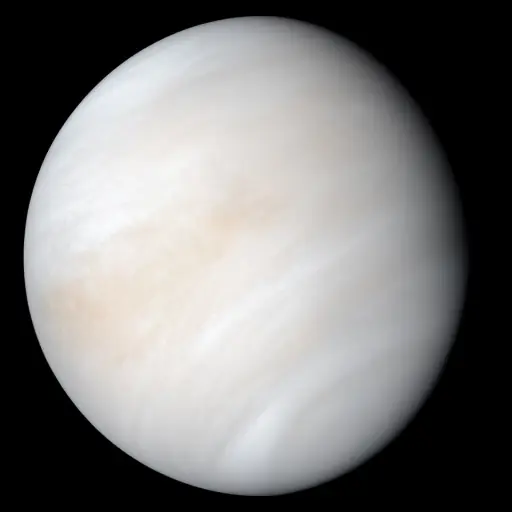
Earth’s twin in size, but a crushing, scorching furnace beneath clouds of sulphuric acid.
Almost Earth’s twin in size and mass, Venus would kill you several ways at once. Its air is mostly carbon dioxide, so dense that the pressure at the surface is 92 times Earth’s and the gas there behaves like a hot fluid. A runaway greenhouse effect holds the ground at about 464 °C, making Venus the hottest planet of all — hotter even than Mercury. Above it all, clouds of sulphuric acid wrap the whole planet.
It also spins slowly, and backwards: one day from sunrise to sunrise lasts about 117 Earth days, roughly half its year. Radar maps show a world shaped by volcanoes — more than 85,000 have been mapped — and fresh looks at old Magellan images have caught signs of eruptions under way. Almost all its features are named after women from history and myth.
Venus even changed our place in the cosmos. Through a telescope it shows phases like the Moon, and by 1613 those phases had been presented as decisive evidence that the planets circle the Sun, not the Earth.
Did you know?
- First across the gulf. Venera 1 flew past Venus in 1961, the first interplanetary spaceflight. In 1970 Venera 7 became the first spacecraft to land on another planet.
- Ray of light. In Old English Venus was Ēarendel, “ray of light”, as well as the morning and evening star. It is the brightest natural point of light in our sky.
- Life in the clouds?. High in its clouds, conditions are the most Earth-like found anywhere else in the Solar System. Possible signs of life reported there in 2020 have spurred new research and missions.
- A young face. Venus has only about a thousand craters, most of them pristine — a sign that its whole surface was renewed by lava some 300 to 600 million years ago.
How big is it?
Almost Earth’s twin: 95% of its width. Venus is 95% of Earth’s width — 12,104 km across. It has 81% of Earth’s mass. A 70 kg person would feel like 63 kg on its surface. It spins so slowly — and backwards — that one turn takes longer than its year: 243 Earth days against 225 Earth days.
In November 2026 Venus is in the morning sky, 39° from the Sun, at magnitude −4.9 in Virgo.
Its place changes from night to night: open AstroPilot for tonight's rise, set and best time from your location.