Uranus
Uranus is a planet of the Solar System. A tiny blue-green disk at higher power; naked-eye threshold under dark skies.
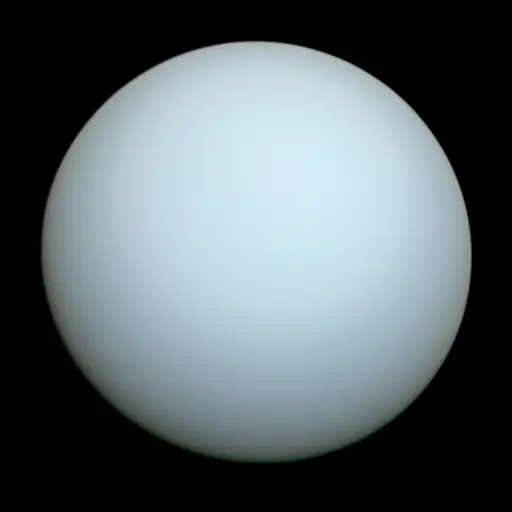
The planet that rolls around the Sun on its side — first taken for a comet, then nearly named after a king.
On 13 March 1781, in the garden of his house in Bath, the musician and astronomer William Herschel noticed something odd. Under higher magnification one ‘star’ grew larger, as a planet would, while the real stars stayed points. He reported a comet. Others worked out its nearly circular orbit and realised it was something far bigger: a new planet, the first found with a telescope, doubling the size of the known Solar System at a stroke.
Herschel wanted to call it Georgium Sidus, ‘George’s Star’, after King George III, who rewarded him with a yearly stipend. Most of Europe preferred Johann Bode’s suggestion: Uranus, the Greek god of the sky and father of Saturn. Britain’s Nautical Almanac Office held out until 1850.
Uranus is an ice giant, its blue-green tint coming from methane, and its axis is tipped so far over that it rolls around the Sun on its side. Each pole gets about 42 years of unbroken sunlight, then 42 years of night. Its atmosphere is the coldest of any planet’s, dropping to about −224 °C.
Did you know?
- Seen, but not recognised. Uranus had been logged as a star long before Herschel. John Flamsteed recorded it at least six times from 1690, cataloguing it as 34 Tauri.
- A namesake element. In 1789 the chemist Martin Klaproth named his newly discovered element uranium in honour of the new planet.
- Rings found by starlight. Uranus’s rings were discovered in 1977, when a star blinked on and off as it passed behind them — an occultation. They are so dark they reflect only about 2% of the light that hits them.
- One visit, ever. Voyager 2 flew past in January 1986 and remains the only spacecraft to visit. US planetary scientists have named a Uranus orbiter and probe a top priority for 2023–2032.
How big is it?
63 Earths could fit inside Uranus. Uranus is 4 times as wide as Earth — 50,724 km across. It weighs as much as 15 Earths. A 70 kg person would feel like 63 kg at its cloud tops — there’s no ground to stand on. It spins on its side, tipped over by 98°: each pole gets 42 years of sunlight, then 42 years of darkness. One trip round the Sun takes 84 Earth years: since its discovery in 1781 it has gone round only twice.
In November 2026 Uranus is in the evening sky, 178° from the Sun, at magnitude 5.6 in Taurus.
Its place changes from night to night: open AstroPilot for tonight's rise, set and best time from your location.