Triton
Triton (Neptune I) is a moon of Neptune, discovered by William Lassell in 1846. It orbits Neptune every 5.9 days and shines at about magnitude 13.5.
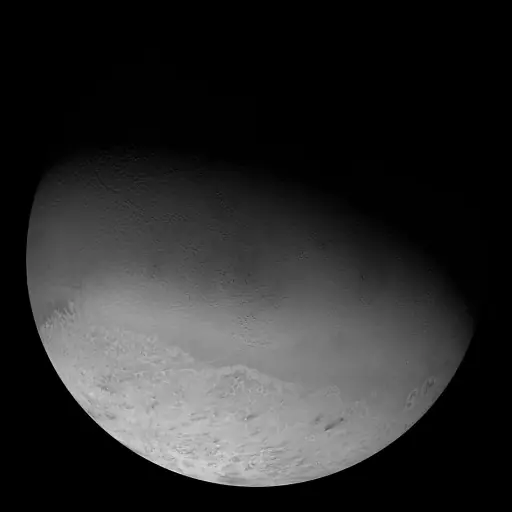
A captured world circling Neptune backwards, with nitrogen geysers and a surface of frozen nitrogen.
Triton goes the wrong way. It circles Neptune backwards, against the planet’s spin — the only large moon in the Solar System to do so. That is a strong clue that it was not born there. Triton was probably a dwarf planet from the Kuiper belt, the icy realm beyond Neptune, until Neptune’s gravity captured it.
When Voyager 2 flew past in 1989 it found one of the youngest surfaces in the Solar System, coated with frozen nitrogen and almost free of craters. Geysers sent dark plumes kilometres high, leaving streaks across the ice. This moon has a thin nitrogen atmosphere with ice clouds and an organic haze, and it may hide an ocean beneath its crust.
William Lassell, a brewer by trade, found Triton on 10 October 1846 — just 17 days after Neptune itself — with a telescope he had built, after John Herschel urged him to look for moons.
Did you know?
- Bigger than Pluto. Triton is larger than any known dwarf planet, Pluto included, and is the seventh-largest moon in the Solar System.
- A name from Flammarion. The name Triton, after the son of Poseidon, was first proposed by Camille Flammarion in 1880. Until 1949 it was simply ‘the satellite of Neptune’.
- A doomed orbit. Because it orbits backwards, Neptune’s tides are slowly dragging Triton inward. In billions of years it may be torn apart, perhaps to become a ring around Neptune.
How big is it?
Our Moon could hold 2.1 moons this size. Triton is 2,707 km across — 78% of our Moon’s width. It has 29% of our Moon’s mass. A 70 kg person would feel like 5.6 kg on its surface.
A captured world that orbits Neptune backwards; up to 17″ from the planet, within reach of an 8-inch scope.
Other moons of Neptune: none.
Open AstroPilot to see where Triton is next to Neptune tonight and how easy it is with your telescope.