Sigma Orionis (σ Ori)
Sigma Orionis (σ Ori) is a double star in the constellation Orion, magnitude 3.8.
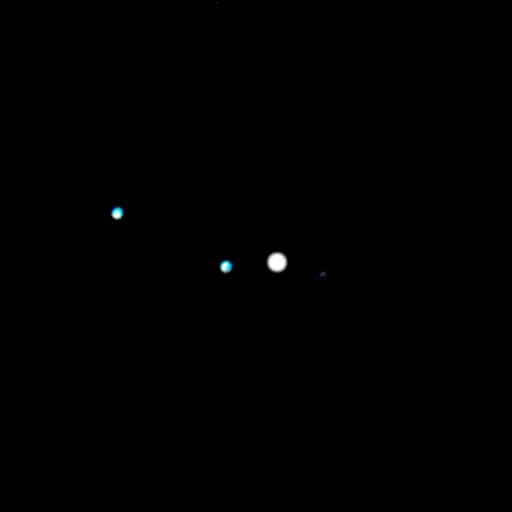
A family of hot young stars at the heart of a cluster teeming with brown dwarfs and planet-mass objects.
At the heart of Sigma Orionis is a triple of hot, young, massive stars, each 11 to 18 times the Sun’s mass. The inner two swing around each other every 143 days on a highly elongated orbit; the third circles them every 157 years. Oddly, the two orbits are tilted almost at right angles to each other.
Around them lies a young cluster, recognised only in 1996, where stars began forming about 3 million years ago. It holds several hundred small members: red dwarfs, brown dwarfs and even objects of planetary mass. In 2024 the ALMA telescope saw rings and gaps in the dusty discs around some young stars — patterns often linked to forming planets. The fierce light of Sigma Orionis may be eroding those discs.
The star has been known since antiquity, yet Ptolemy left it out of his Almagest. In 1776 Christian Mayer saw that it was triple, and observers have been finding more members ever since.
Sigma Orionis (σ Ori) is 1,100 light-years away: the light we see from it set off around AD 930, around the time al-Sufi described the Andromeda Galaxy in his Book of Fixed Stars.
Did you know?
- A magnetic oddity. Sigma Orionis E is unusually rich in helium and has an abnormally strong magnetic field — features astronomers pieced together between 1956 and 1979.
- Heavier than expected. Masses worked out from the stars’ orbits come out larger than stellar models predict for stars like these, a mismatch that is still being studied.
- Five gaps in a row. One young star in the cluster, Haro 5-34, has five gaps in its disc, seemingly arranged in a resonant chain.
How big is it?
176 Suns could fit inside it. Its main star is 5.6 times as wide as the Sun — about 7.8 million km across. It gives off as much light as 42,000 Suns. It has 18 times the Sun’s mass — heavy enough to end its life as a supernova. Its companion star is at least 4,550 times Earth’s distance from the Sun away — 151 times as far as Neptune is from the Sun.
A multiple star just southwest of Alnitak whose brightest member lights up IC 434, the glow behind the Horsehead. The bright pair σ Ori AB and companion D (magnitudes 3.8 and 6.6) lie 13.5″ apart at PA 84° (measured 2021). E (magnitude 6.3) lies 42″ away and C (magnitude 8.8) 11.4″ away.
When and where to see it
It is best placed in the evening sky around January, when it crosses the meridian at about 10 pm local time (around midnight in December). It can be seen from everywhere south of 87°N and never sets south of 87°S.
At its highest it stands 37° up from 50°N, 52° up from 35°N, 87° up from the equator, 58° up from 35°S.
Facts
- Type
- Double star
- Constellation
- Orion
- Designations
- σ Ori, 48 Ori, 48 Orionis, STF 762, HIP 26549
- Magnitude
- 3.8
- Position
- RA 5h 38.7m, Dec −2° 36′ (J2000)
- Distance
- 1,100 light-years
- Discovered
- Christian Mayer, 1776, Seen as triple in 1776; the star itself known since antiquity
Open AstroPilot to see when Sigma Orionis (σ Ori) is highest tonight from your location, how easy it is with your telescope or binoculars, and an eyepiece view.