Rigel (β Ori)
Rigel (β Ori) is a double star in the constellation Orion, magnitude 0.3.
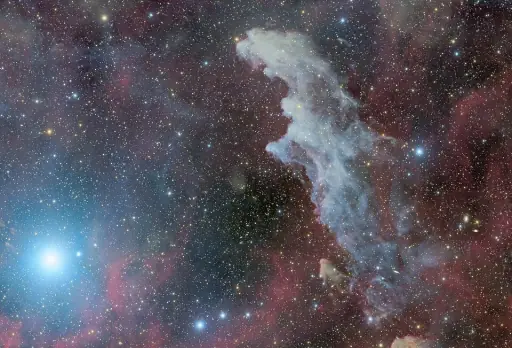
Orion’s blazing blue foot — a supergiant tens of thousands of times brighter than the Sun, bound for a supernova.
Rigel shines somewhere between 61,500 and 363,000 times as brightly as the Sun — the wide range shows how hard such a star is to pin down. It is a blue supergiant of 18 to 24 solar masses that, in just seven to nine million years, has already used up the hydrogen in its core and swollen. It will end as a supernova, leaving a neutron star or a black hole behind.
Its surface is restless. Rigel’s light flickers irregularly as its unstable atmosphere pulsates, and its spectrum shows gas surging outwards — and occasionally falling back — in great looping structures thought to be shaped by magnetic fields. Its wind carries away mass about ten million times faster than the Sun’s.
Rigel does not shine alone. Its faint companion is really three stars, each three to four times the Sun’s mass, and the whole family may take some 24,000 years to circle its common centre.
Rigel (β Ori) is 860 light-years away: the light we see from it set off around 1165, 110 years after Chinese astronomers recorded the supernova that made the Crab Nebula.
Did you know?
- Why Beta?. Rigel is almost always brighter than Betelgeuse, yet Bayer labelled it Beta in 1603. Perhaps Betelgeuse was having a rare bright spell — or Bayer simply listed first-magnitude stars from north to south.
- A yardstick for supergiants. Rigel’s spectrum is a defining point of the classification sequence for supergiants, a reference that other stars are measured against.
- A sailor’s star. Rigel is an important navigation star, easy to find and visible from all the world’s oceans except the far Arctic, north of about 82° latitude.
How big is it?
410,000 Suns could fit inside it. Its main star is 74 times as wide as the Sun — about 100 million km across. Light takes 6 minutes to cross it; it crosses the Sun in under five seconds. For all its size it holds only 21 Suns’ worth of matter: on average it is thinner than the air you breathe. It gives off as much light as 120,000 Suns. That is still heavy enough for it to end its life as a supernova. Its companion star is at least 2,480 times Earth’s distance from the Sun away — 82 times as far as Neptune is from the Sun.
The brilliant blue-white supergiant of Orion; its faint companion is a classic test of optics in the glare. Its components (magnitudes 0.3 and 6.8) lie 9.4″ apart at PA 204° (measured 2023).
When and where to see it
It is best placed in the evening sky around January, when it crosses the meridian at about 10 pm local time (around midnight in December). It can be seen from everywhere south of 82°N and never sets south of 82°S.
At its highest it stands 32° up from 50°N, 47° up from 35°N, 82° up from the equator, 63° up from 35°S.
Facts
- Type
- Double star
- Constellation
- Orion
- Designations
- β Ori, Beta Orionis, 19 Ori, 19 Orionis, STF 668, HIP 24436
- Magnitude
- 0.3
- Position
- RA 5h 14.5m, Dec −8° 12′ (J2000)
- Distance
- 860 light-years
- Discovered
- Known since antiquity
Open AstroPilot to see when Rigel (β Ori) is highest tonight from your location, how easy it is with your telescope or binoculars, and an eyepiece view.