Polaris (α UMi)
Polaris (α UMi) is a double star in the constellation Ursa Minor, magnitude 2.0.
The North Star: not the brightest, not quite at the pole, and a stranger star than it looks.
The whole northern sky seems to wheel around Polaris, because it sits almost exactly above Earth’s North Pole. Its height above your horizon roughly matches your latitude, which made it a lifeline for navigators. Yet it is not the brightest star in the sky, as many people think — it ranks only about 47th.
It is also a star with secrets. Polaris is the nearest Cepheid, a pulsing supergiant of the kind astronomers use to measure the cosmos. But its pulses have behaved oddly: after 1966 they shrank sharply, and they now seem to be growing again — a reversal not seen in any other Cepheid. Research even suggests it is about 2.5 times brighter than when Ptolemy observed it.
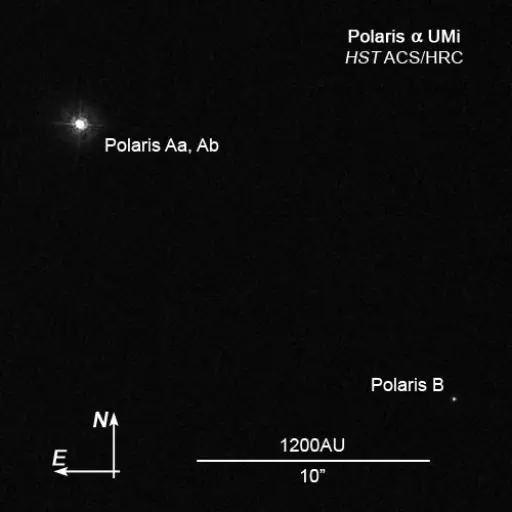
Polaris is a triple. William Herschel found its outer companion in August 1779 with a reflecting telescope of his own; a much closer partner, circling about every 30 years, was only confirmed in the early 20th century. In 2006 the Hubble Space Telescope showed all three.
Polaris (α UMi) is 430 light-years away: the light we see from it set off around 1595, around the time Galileo first turned a telescope to the sky.
Did you know?
- Weighed by its partner. Polaris was the first classical Cepheid to have its mass measured from an orbit. A 2024 study put it at about five times the Sun’s mass.
- Spots on a supergiant. In 2024 a team using the CHARA Array tentatively imaged large bright and dark patches on its surface, changing over time.
- An age puzzle. The supergiant appears much younger than its two companions — strange, since the stars of a triple system would normally have formed together.
- A temporary title. Earth’s axis slowly wobbles, so the pole drifts among the stars. Polaris will be closest to the pole soon after 2100, then slowly drift away from it.
How big is it?
99,000 Suns could fit inside it. Its main star is 46 times as wide as the Sun — about 64 million km across. Light takes 4 minutes to cross it; it crosses the Sun in under five seconds. For all its size it holds only 5.1 Suns’ worth of matter: on average it is thinner than the air you breathe. It gives off as much light as 1,260 Suns. Its companion star is at least 2,430 times Earth’s distance from the Sun away — 81 times as far as Neptune is from the Sun.
The North Star has a faint companion visible in small telescopes. Its components (magnitudes 2.0 and 9.1; spectral types F7 Ib (yellow-white) and F3 V (yellow-white)) lie 18.4″ apart at PA 236° (measured 2016).
When and where to see it
It is best placed in the evening sky around December, when it crosses the meridian at about 10 pm local time (around midnight in November). It can be seen from everywhere north of 1°S and never sets north of 1°N.
At its highest it stands 51° up from 50°N, 36° up from 35°N, 1° up from the equator, below the horizon from 35°S.
Facts
- Type
- Double star
- Constellation
- Ursa Minor
- Designations
- α UMi, Alpha Ursae Minoris, 1 UMi, 1 Ursae Minoris, STF 93, HIP 11767
- Magnitude
- 2.0
- Position
- RA 2h 31.8m, Dec +89° 16′ (J2000)
- Distance
- 430 light-years
- Discovered
- William Herschel, 1779, Outer companion found in 1779; the star itself known since antiquity
Open AstroPilot to see when Polaris (α UMi) is highest tonight from your location, how easy it is with your telescope or binoculars, and an eyepiece view.