Nu Draconis (Kuma)
Nu Draconis (Kuma) is a double star in the constellation Draco, magnitude 4.9.
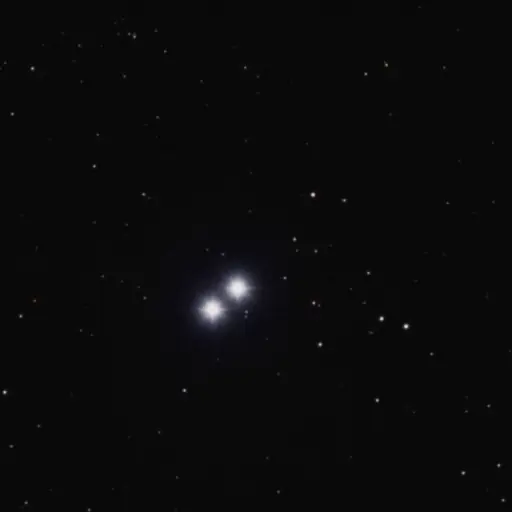
Two matched white stars in the Dragon’s head — once among the “Mother Camels” of Arabic star lore.
Side by side, two white stars of almost equal brightness travel through space together. They share the same distance, the same motion across the sky and the same speed along our line of sight, though they are so far apart that no orbital movement has ever been seen.
They even share a chemical quirk. Each is an “Am” star, with abnormally strong lines of metals in its light. One of them also hides a small companion, never seen directly but betrayed by the tug it gives every 38 days on a nearly circular orbit.
Arabic astronomers counted it among Al ‘Awā’id, “the Mother Camels” — five stars of the Dragon’s head, later called the Quinque Dromedarii. Its modern name, Kuma, first appeared in Antonín Bečvář’s 1948 Skalnaté Pleso Atlas of the Heavens.
Nu Draconis (Kuma) is 98 light-years away: the light we see from it set off in 1928, around the time Pluto was discovered.
Did you know?
- A name of obscure origin. The astronomer James B. Kaler calls the name Kuma “of obscure origin”; one source has suggested it means “at last”.
- The Celestial Flail. In Chinese astronomy it is the second star of Tiān Bàng, the Celestial Flail, together with Rastaban, Eltanin, Xi Draconis and Iota Herculis.
How big is it?
1.8 times as wide as the Sun — and 8.1 times as bright. Its main star is about 2.5 million km across. It has twice the Sun’s mass. Its companion star is at least 1,870 times Earth’s distance from the Sun away — 62 times as far as Neptune is from the Sun.
A matched pair of white stars, easily split in binoculars. Its components (magnitudes 4.9 and 4.9; spectral types A4 (white) and A6 V (white)) lie 62.2″ apart at PA 308° (measured 2023).
When and where to see it
It is best placed in the evening sky around July, when it crosses the meridian at about 10 pm local time (around midnight in June). It can be seen from everywhere north of 35°S and never sets north of 35°N.
At its highest it stands 85° up from 50°N, 70° up from 35°N, 35° up from the equator, below the horizon from 35°S.
Facts
- Type
- Double star
- Constellation
- Draco
- Designations
- Kuma, ν Dra, ν² Dra, Nu² Draconis, ν¹ Dra, Nu¹ Draconis, 25 Dra, 25 Draconis, 24 Dra, 24 Draconis, STFA 35, HIP 85829
- Magnitude
- 4.9
- Position
- RA 17h 32.3m, Dec +55° 10′ (J2000)
- Distance
- 98 light-years
Open AstroPilot to see when Nu Draconis (Kuma) is highest tonight from your location, how easy it is with your telescope or binoculars, and an eyepiece view.