Neptune
Neptune is a planet of the Solar System. Faint bluish point that resolves into a small disk at 200×+; Triton is within reach of 8".
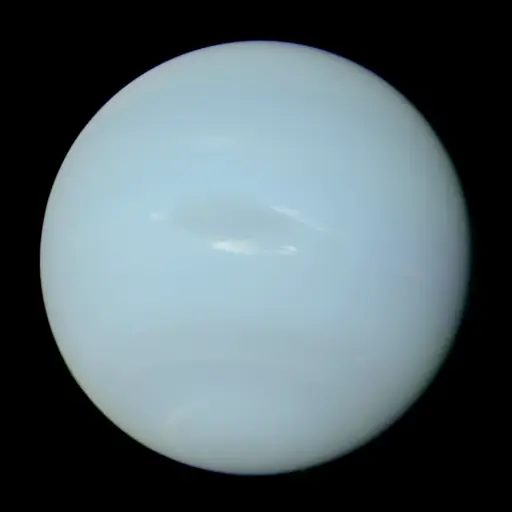
The planet found by mathematics before anyone knew where to look — home to the fastest winds of any planet.
Uranus was misbehaving. Decades after its discovery it was straying from its predicted path, as if something unseen were tugging on it. In Paris, Urbain Le Verrier calculated where that something must be and wrote to Johann Galle at the Berlin Observatory. On 23 September 1846, the evening the letter arrived, Galle — helped by the student Heinrich d’Arrest and a fresh star chart — found the new planet within a degree of the predicted spot. In England, John Couch Adams had made similar calculations.
Neptune is an ice giant, a little smaller than Uranus but denser and more massive, tinted blue by methane. For a world so far from the Sun it is restless. Its winds reach 2,100 km/h, the strongest of any planet. When Voyager 2 flew past in 1989 — still the only spacecraft to visit — it found a Great Dark Spot, a storm comparable to Jupiter’s Great Red Spot. A few years later, Hubble found it had vanished.
Did you know?
- Galileo saw it first. Galileo’s drawings from December 1612 and January 1613 show a ‘star’ near Jupiter that matches Neptune’s position. It barely moved, so he never knew what he had seen.
- The one that got away. At Cambridge, James Challis had searched using Adams’s predictions and recorded Neptune twice without recognising it. He blamed out-of-date star maps.
- Le Verrier’s planet. Le Verrier tried to have the planet named after himself. The idea met stiff resistance outside France, and Neptune, the Roman god of the sea, won the day.
- A very long year. Neptune takes 164.8 years to circle the Sun. It completed its first full orbit since its discovery only in 2011.
How big is it?
58 Earths could fit inside Neptune. Neptune is 3.9 times as wide as Earth — 49,244 km across. It weighs as much as 17 Earths. A 70 kg person would feel like 80 kg at its cloud tops — there’s no ground to stand on. One trip round the Sun takes 165 Earth years: since its discovery in 1846 it has gone round just once, completing that first lap in 2011.
In November 2026 Neptune is in the evening sky, 116° from the Sun, at magnitude 7.9 in Pisces.
Its place changes from night to night: open AstroPilot for tonight's rise, set and best time from your location.