Moon
The Moon is Earth's natural satellite and the easiest telescope target of all. Craters, maria and mountain ranges; best near the terminator, away from full Moon.
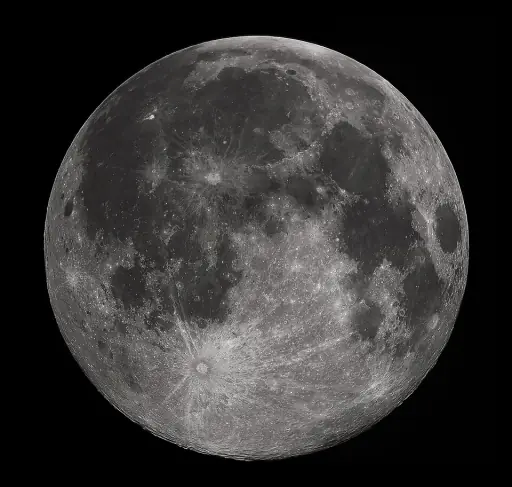
Born in a collision, as dark as asphalt, and the only world beyond Earth where people have walked.
The Moon was probably born in violence. The leading theory says a Mars-sized world, named Theia, struck the young Earth and blasted material into orbit, where it gathered into the Moon roughly 4.4 to 4.5 billion years ago. That would explain why Earth and Moon rocks have nearly identical isotopic make-up — and simulations from 2023 suggest remnants of Theia may still lie deep inside Earth.
Since then Earth’s tides have locked the Moon so that it always turns the same face to us, and have slowly pushed it outwards; long ago it loomed far larger in our sky. The dark maria, or “seas”, are vast plains of lava that welled up until about 1.2 billion years ago, mostly on the near side. For all its brilliance at night, its surface is about as reflective as asphalt.
It remains the only world beyond Earth that people have visited. Apollo 11 landed on 20 July 1969, and by 1972 six Apollo missions had put twelve astronauts on its surface. In 2026 the crew of Artemis II flew around it.
Did you know?
- A perfect fit. By coincidence the Moon and the Sun look almost the same size in our sky, which is why the Moon can cover the Sun completely in a total solar eclipse.
- More than half. Thanks to libration, a slight rocking of the Moon as seen from Earth, we can see about 59% of its surface over time.
- The first visitors. The Soviet Luna 2 became the first spacecraft to strike the Moon in 1959, and Luna 9 made the first soft landing in 1966.
- A word for time. The word moon comes from Old English mōna, and further back from an ancient root meaning “month” — possibly linked to a verb for measuring time.
How big is it?
About 49 Moons would fill Earth — and it would take 81 to match its weight. The Moon is 27% of Earth’s width — 3,475 km across. A 70 kg astronaut feels like 12 kg there, which is why the Apollo crews bounded instead of walking. On average it is 384,400 km away — about 30 Earths side by side. All the other planets, lined up, would fit in the gap when the Moon is at its farthest: together they are 380,016 km wide. A day there, sunrise to sunrise, lasts 29.5 Earth days: two weeks of sunlight, then two weeks of night.
Its place changes from night to night: open AstroPilot for tonight's rise, set and best time from your location.