Mizar and Alcor
Mizar and Alcor is a double star in the constellation Ursa Major, magnitude 2.2.
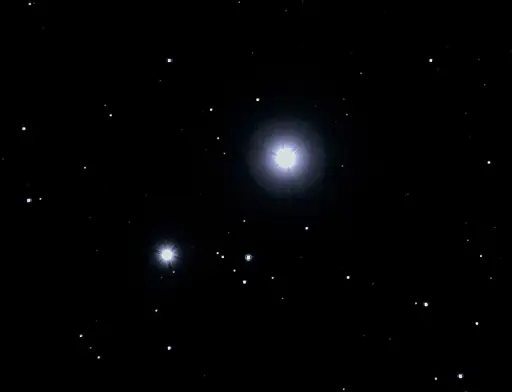
The Plough’s horse and rider — and the very first star shown to be a binary from its light alone.
In 1617 Benedetto Castelli asked Galileo to turn a telescope on Mizar, and Galileo made a detailed record of what he saw: two stars where the eye sees one. It may have been the first double star known to Europeans through a telescope.
Its next first came from Harvard. During Antonia Maury’s work classifying stellar spectra, the brighter star’s light turned out to come from two stars circling every 20½ days, far too close to see apart. It was the first spectroscopic binary ever discovered, and its orbit was published in 1890. In 1908 the fainter star proved to be a close pair as well.
Alcor completes the family. Arab sky-watchers called the two the horse and rider. To the Mi’kmaq, in the story of the great bear and the seven hunters, Mizar is Chickadee and Alcor is his cooking pot.
Mizar and Alcor is 86 light-years away: the light we see from it set off in 1940, 10 years after Pluto was discovered.
Did you know?
- Seen at last. In 1996, 107 years after their discovery, the two stars of Mizar A were finally imaged directly, using the Navy Prototype Optical Interferometer.
- One of the seven sages. In traditional Indian astronomy Mizar is Vashistha, one of the Saptarishi — the seven sages whose stars make up the Plough.
- A rock-song star. Steely Dan name-check Mizar in their song “Sign In Stranger”, from the album The Royal Scam.
- Travelling together. Mizar, Alcor and many of the other bright stars of the Plough belong to the Ursa Major Moving Group, a family of stars drifting through space together.
How big is it?
2.4 times as wide as the Sun — and 33 times as bright. Its main star is about 3.3 million km across. It has 2.2 times the Sun’s mass. Its companion star is at least 380 times Earth’s distance from the Sun away — 13 times as far as Neptune is from the Sun.
The famous double in the handle of the Big Dipper; together with Alcor it forms a sextuple star system. Mizar A and B (magnitudes 2.2 and 3.9) lie 14.4″ apart at PA 153° (measured 2022). Alcor (magnitude 4.0) lies 715.5″ (11.9′) from Mizar, an easy naked-eye pair.
When and where to see it
It is best placed in the evening sky around May, when it crosses the meridian at about 10 pm local time (around midnight in April). It can be seen from everywhere north of 35°S and never sets north of 35°N.
At its highest it stands 85° up from 50°N, 70° up from 35°N, 35° up from the equator, 0° up from 35°S.
Facts
- Type
- Double star
- Constellation
- Ursa Major
- Designations
- Mizar, Alcor, ζ UMa, Zeta Ursae Majoris, g UMa, g Ursae Majoris, 79 UMa, 79 Ursae Majoris, 80 UMa, 80 Ursae Majoris, STF 1744, HIP 65378
- Magnitude
- 2.2
- Position
- RA 13h 23.9m, Dec +54° 55′ (J2000)
- Distance
- 86 light-years
- Discovered
- Galileo Galilei, 1617, Observed at Benedetto Castelli’s request; Mizar and Alcor have been a naked-eye pair since antiquity
Open AstroPilot to see when Mizar and Alcor is highest tonight from your location, how easy it is with your telescope or binoculars, and an eyepiece view.