Mercury
Mercury is a planet of the Solar System. Elusive inner planet, only visible low in twilight near greatest elongation; shows phases.
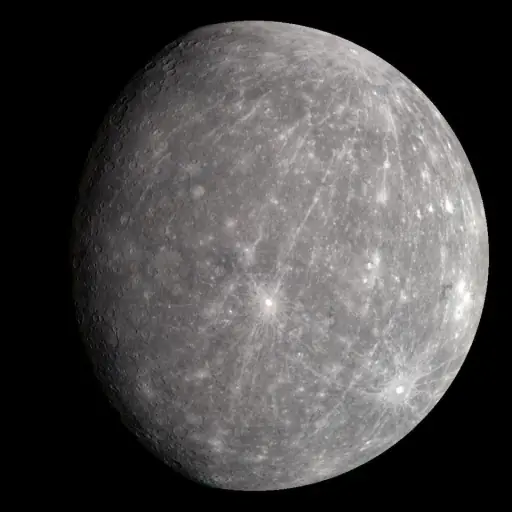
A scorched iron world where one day lasts two of its years — the Sun’s swift messenger.
On Mercury, one day from sunrise to sunrise lasts 176 Earth days — two of its years. The planet spins exactly three times for every two trips around the Sun, so each side bakes in sunlight for a whole Mercurian year, then freezes through a night just as long. At the equator, days reach 420 °C and nights plunge to −170 °C.
Inside, it is mostly metal: its iron-rich core fills more than half the planet’s volume, against less than a fifth for Earth. Perhaps a giant impact stripped away much of its rocky mantle, or perhaps the young Sun’s heat drove it off. NASA’s MESSENGER probe found surface chemistry that argues against both ideas, and the European–Japanese BepiColombo mission, arriving in 2026, will test them further.
As the core cooled, the whole planet contracted, wrinkling its crust into long ridges. The ancient Greeks realised by about 350 BC that the morning and evening “stars” were one object; the Romans named it after their swift messenger god, because it moves across the sky faster than any other planet.
Did you know?
- Ice on the planet nearest the Sun. Mercury’s axis barely tilts, so the floors of some polar craters never see sunlight. Water ice is strongly suspected to be hiding there.
- Craters for artists. Mercury’s craters are named after artists, musicians, painters and authors; its mountains after the word “hot” in different languages; its valleys after abandoned cities of antiquity.
- Smaller than two moons. Mercury is smaller than Jupiter’s moon Ganymede and Saturn’s moon Titan — though it outweighs them both.
How big is it?
Earth could hold 18 planets the size of Mercury. Mercury is 38% of Earth’s width — 4,879 km across. It has 6% of Earth’s mass. A 70 kg person would feel like 26 kg on its surface. From one sunrise to the next takes 176 Earth days — 2 of its years.
In November 2026 Mercury is in the morning sky, 18° from the Sun, at magnitude −0.6 in Libra.
Its place changes from night to night: open AstroPilot for tonight's rise, set and best time from your location.