Mars
Mars is a planet of the Solar System. Polar caps and dark albedo markings appear near opposition, when the disk is largest.
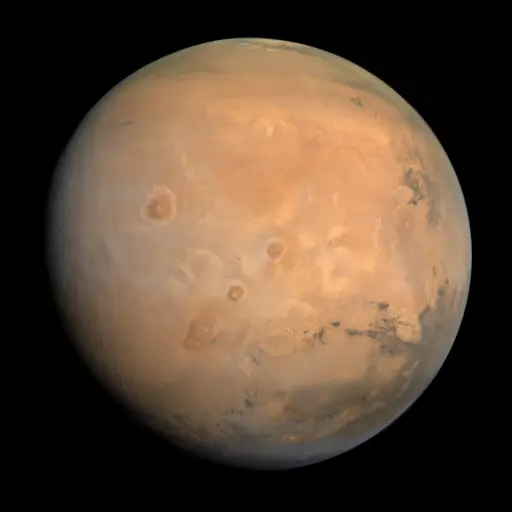
A rusty desert of giant volcanoes, perhaps a lost ring — and more robot visitors than any other planet.
Mars owes its colour to rust: iron oxide dust coats the ground and hangs in the thin air, which is mostly carbon dioxide at less than a hundredth of Earth’s pressure. Up close the dust can look butterscotch, golden or brown. With an axis tilted much like Earth’s, Mars has seasons, and its day lasts just 24.6 hours.
It is a world of extremes. Olympus Mons, the tallest of its extinct volcanoes, rises about two and a half times higher than Everest, and Valles Marineris is one of the largest canyons in the Solar System. Billions of years ago water carved valleys and vast flood channels here, and may even have filled oceans. Whether life ever arose is still an open question.
No planet beyond Earth has had more robot visitors. Mariner 4 flew past in 1965; in 1971 Mariner 9 became the first spacecraft to orbit another planet, and Mars 3 made the first landing. Probes have worked there without a break since 1997, sometimes more than ten at once.
Did you know?
- A lost ring?. A 2023 study suggests Mars may once have had a ring, made from a moon about 20 times heavier than Phobos — and that Phobos itself could be a remnant of it.
- Marsquakes. NASA’s InSight lander recorded more than 450 marsquakes and related events, helping to show that Mars has an iron core that is at least partly molten.
- A planet of two halves. Its smooth northern lowlands and cratered southern highlands may be the scar of a giant impact by a Pluto-sized body about four billion years ago.
- Toxic soil. The Phoenix lander found Martian soil to be slightly alkaline and laced with perchlorate, at levels toxic to humans.
How big is it?
Earth could hold 6.6 planets the size of Mars. Mars is 53% of Earth’s width — 6,779 km across. It has 11% of Earth’s mass. A 70 kg person would feel like 26 kg on its surface. A day lasts 24 h 40 min — almost the same as ours.
In November 2026 Mars is in the morning sky, 95° from the Sun, at magnitude 0.5 in Leo.
Its place changes from night to night: open AstroPilot for tonight's rise, set and best time from your location.