Jupiter
Jupiter is a planet of the Solar System. Cloud belts, the Great Red Spot and four Galilean moons that change nightly.
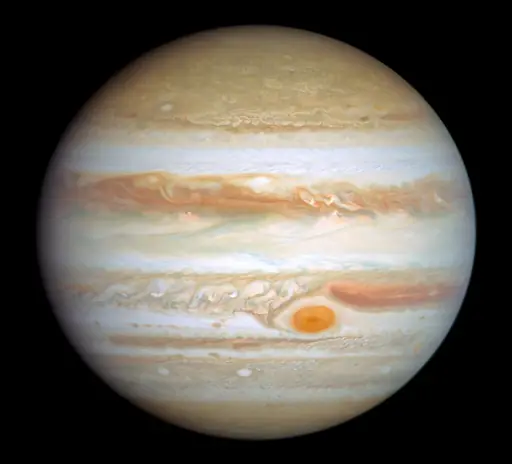
The oldest, biggest planet — a giant that may have shaped the whole Solar System, and is still shrinking.
Jupiter was probably the first planet to form, just a million years after the Sun and tens of millions of years before Earth. It outweighs all the other planets put together two and a half times over. As it grew it may have wandered in towards the Sun and back out again — a journey some scientists think cleared the way for Earth and the other rocky planets to form from the rubble.
It spins in about ten hours, so fast that its middle bulges outwards. Its stripes are bands of cloud, with storms where they meet; the largest, the Great Red Spot, has been recorded since 1831. Deep inside, hydrogen is squeezed into a liquid metal that drives the strongest magnetic field of any planet. Jupiter even gives off more heat than it receives from the Sun, as its interior slowly contracts — by about a millimetre a year.
At least 115 moons circle it. The four largest, the Galilean moons, show up in ordinary binoculars, and Ganymede is bigger than the planet Mercury.
Did you know?
- Pulling on the Sun. Jupiter is so massive that the balance point it shares with the Sun lies just outside the Sun’s surface.
- Jovial by name. The word “jovial” comes from Jupiter: medieval astrologers believed the planet brought on a happy, merry mood.
- As big as it gets. Add 40% more mass and Jupiter would actually get smaller, squeezed by its own gravity. It is about as wide as a planet of its kind can be.
- Moons named for lovers. The IAU names Jupiter’s newly found moons after the god’s lovers, favourites and descendants.
How big is it?
1,320 Earths could fit inside Jupiter. Jupiter is 11 times as wide as Earth — 139,822 km across. It weighs as much as 318 Earths. A 70 kg person would feel like 177 kg at its cloud tops — there’s no ground to stand on. A whole day lasts just 9 h 56 min, so fast that Jupiter bulges at its equator.
In November 2026 Jupiter is in the morning sky, 99° from the Sun, at magnitude −2.2 in Leo.
Its place changes from night to night: open AstroPilot for tonight's rise, set and best time from your location, and where its four Galilean moons are.