Iota Cancri (ι Cnc)
Iota Cancri (ι Cnc) is a double star in the constellation Cancer, magnitude 4.1.
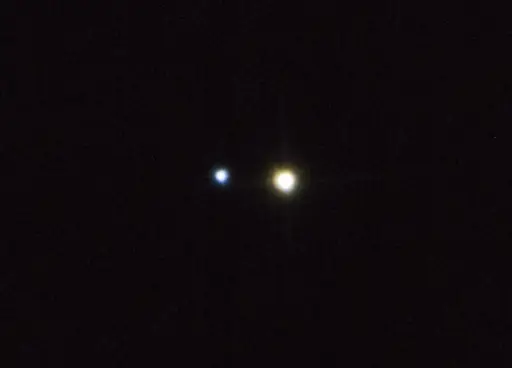
A yellow giant and a fast-spinning white star, named in 2026 after the freshwater crab of Javanese skies.
The yellow giant here carries the chemical fingerprint of a vanished companion. It is a mild “barium star”, its atmosphere enriched with elements forged inside a more evolved kind of giant. The likely explanation: another star once dumped that material onto it, then faded into a white dwarf that has never been seen.
Its partner is a hot white star spinning so fast — at least 170 kilometres a second at its equator — that it has flung off a shell of material around itself. The two drift through space together, but they are so far apart that no orbit has been measured.
In Bali the whole constellation of Cancer is called Yuyu, a Javanese word for the freshwater crab of the rice fields, attested for at least 1,300 years. In 2026 the IAU gave that name to the brighter star.
Iota Cancri (ι Cnc) is 350 light-years away: the light we see from it set off around 1675, around the time Isaac Newton published his laws of motion and gravity.
Did you know?
- The crab’s claws. Arabic astronomers called this star and Alpha Cancri Al Zubanāh, “the claws” of the crab — the source of Alpha Cancri’s modern name, Acubens.
- Where the colours come from. The giant’s surface is about 4,950 kelvins, while its partner’s is nearly twice as hot, around 9,260 — the reason the pair shows such a strong colour contrast.
How big is it?
9,260 Suns could fit inside it. Its main star is 21 times as wide as the Sun — about 29 million km across. Light takes 97 seconds to cross it; it crosses the Sun in under five seconds. For all its size it holds only 2.4 Suns’ worth of matter: on average it is thinner than the air you breathe. It gives off as much light as 204 Suns. Its companion star is at least 3,270 times Earth’s distance from the Sun away — 109 times as far as Neptune is from the Sun.
A wide, easy color-contrast pair in Cancer, often compared to Albireo. Its components (magnitudes 4.1 and 6.6; spectral types G8 III (yellow) and A2 V (white)) lie 30.5″ apart at PA 308° (measured 2022).
When and where to see it
It is best placed in the evening sky around March, when it crosses the meridian at about 10 pm local time (around midnight in January). It can be seen from everywhere north of 61°S and never sets north of 61°N.
At its highest it stands 69° up from 50°N, 84° up from 35°N, 61° up from the equator, 26° up from 35°S.
Facts
- Type
- Double star
- Constellation
- Cancer
- Designations
- ι Cnc, 48 Cnc, 48 Cancri, STF 1268, HIP 43103
- Magnitude
- 4.1
- Position
- RA 8h 46.7m, Dec +28° 46′ (J2000)
- Distance
- 350 light-years
Open AstroPilot to see when Iota Cancri (ι Cnc) is highest tonight from your location, how easy it is with your telescope or binoculars, and an eyepiece view.